Table of Contents
ToggleIntroduction: A Tale of Two Global Cities
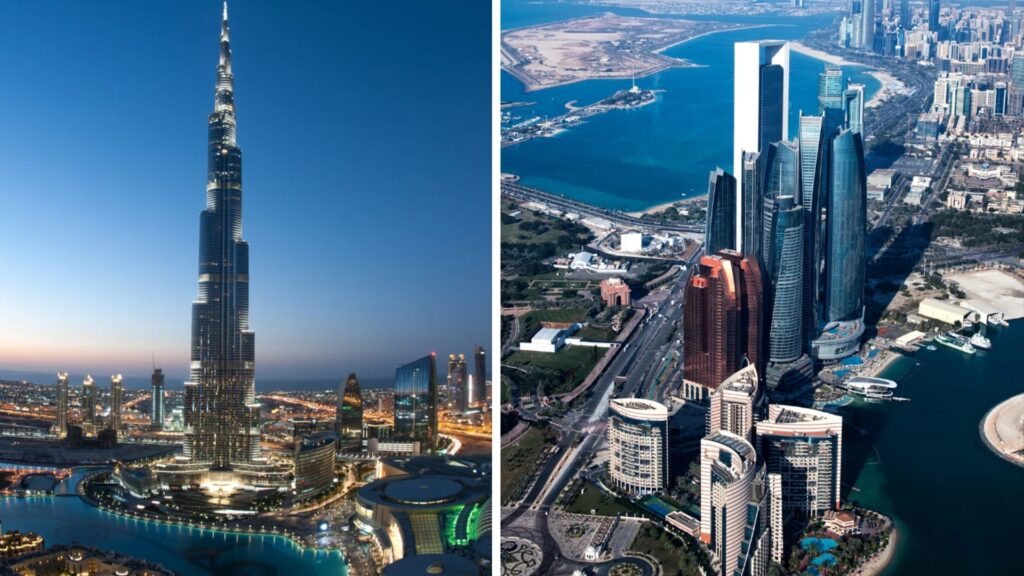
The most frequent question I receive from international investors is: “Should I buy in Abu Dhabi or Dubai?” As we navigate the high-stakes landscape of 2026, the answer has become increasingly nuanced. While both emirates are experiencing a historic surge in luxury demand, they offer fundamentally different—yet equally compelling—value propositions. Dubai, the high-octane global commercial hub, continues to break transaction records with AED 554 billion in sales in 2025. However, Abu Dhabi is strategically carving out its own distinct chapter as the “Cultural Capital,” offering a more discerning proposition focused on low-density, sustainable, and art-integrated living that uniquely appeals to legacy wealth and those seeking enduring value . For the sophisticated investor, the choice between the two is no longer about which is “better,” but about which emirate offers the most strategic alignment with their long-term asset allocation and lifestyle aspirations.
Phase I: The Comparative Metrics of 2026
To understand the current market, we must look at the data driving the 2026 luxury narrative.
1. The Pricing Gap and Entry Strategy
One of the most compelling arguments for Abu Dhabi in 2026 is the pricing differential. On average, prime luxury properties in Abu Dhabi sit around AED 1,250 to 1,400 per square foot, which is roughly 30% less than comparable assets in Dubai . For UHNWIs, this represents a critical strategic entry point into a world-class market, offering unparalleled value before the next wave of handovers on Saadiyat and Yas Islands inevitably narrows this significant gap. In contrast, Dubai’s ultra-luxury segments, particularly in Palm Jumeirah and Jumeirah Bay, are consistently exceeding AED 3,500 per square foot, driven by extreme scarcity and global demand for ready-to-move-in status symbols .
2. Yield Dynamics and Passive Income
Both markets continue to offer some of the highest rental yields globally. In 2026, Abu Dhabi’s prime rental yields are projected to reach 5.7% to 6.5%, with certain mid-market segments like Al Reef providing gross yields as high as 8.5% . Dubai remains slightly ahead in terms of pure yield volume, with many communities still delivering 7% to 9% net returns . Crucially, Abu Dhabi’s yields are consistently viewed as more stable and predictable, underpinned by the city’s high proportion of long-term residents, robust government-linked employment, and a meticulously planned economic diversification strategy.
Phase II: Stability vs. Dynamism – Choosing Your Market
The decision between Abu Dhabi and Dubai often comes down to the investor’s risk-reward profile and lifestyle goals.
Abu Dhabi: The Case for Capital Preservation and Legacy
Abu Dhabi’s real estate market is meticulously built on a foundation of visionary long-term master-planning, positioning it as a true safe haven for discerning capital. The unwavering focus here is on “Ecosystem Living”—seamlessly integrating residential life with world-class cultural institutions like the Louvre, pristine mangroves, and elite educational facilities. This makes Abu Dhabi the unequivocal preferred choice for families and investors whose primary focus is on robust capital preservation, enduring value, and the “guaranteed” steady growth inherent in a meticulously managed economy . Clients are increasingly choosing the capital for its unparalleled privacy, lower density, and the unwavering commitment to the long-term vision of the 2030 Economic Vision.
Dubai: The Case for High-Octane Growth and Liquidity
Dubai, while offering undeniable dynamism, caters to investors seeking rapid capital appreciation and high liquidity, often accompanied by a higher risk profile. Its market is incredibly fast-paced, characterized by a high volume of secondary transactions and a constant influx of new, branded projects. Dubai’s integration of lifestyle, retail, and commerce is certainly robust, making it a choice for those who thrive in a high-energy, global financial and tourism hub. However, the growth here is more volatility-driven, offering higher potential rewards for those who can time the market effectively .
Investment Strategy: The Diversified UAE Portfolio
In 2026, the smartest investors are not choosing one over the other; they are diversifying across both.
A truly optimized UAE portfolio, however, recognizes Abu Dhabi as the essential anchor. While high-yield, high-density apartments in Dubai’s Business Bay or Marina can provide immediate cash flow, the bedrock of long-term capital appreciation and dynastic security is increasingly found in large-plot family villas within Abu Dhabi’s Saadiyat Lagoons or Ramhan Island. This “Emirates-Wide” strategy allows investors to strategically capture the dynamic opportunities of Dubai while firmly anchoring their wealth in the unparalleled stability and profound cultural prestige of Abu Dhabi. Navigating the differing regulatory frameworks—DARI in the capital and the DLD in Dubai—requires professional oversight to ensure a seamless acquisition process.
The Intangible Asset: The Cultural Premium
Beyond the square footage and ROI, there is an “Intangible Asset” at play in Abu Dhabi: The Cultural Premium.
The proximity to the Louvre Abu Dhabi, the Guggenheim, and the upcoming Zayed National Museum adds a layer of prestige that is difficult to quantify but impossible to ignore. In 2026, the very definition of luxury is evolving, increasingly defined by intellectual and cultural enrichment—an arena where Abu Dhabi unequivocally excels. For the global elite, owning a home in the Saadiyat Cultural District is far more than a real estate play; it is a profound statement of cultural literacy, discerning taste, and a long-term commitment to the region’s most prestigious and intellectually stimulating address.
Conclusion: Mastering the Dual-Market Landscape
The 2026 luxury real estate landscape presents a compelling choice, but for the astute investor, Abu Dhabi emerges as the clear strategic frontrunner. While Dubai offers the undeniable thrill of a high-growth, high-liquidity market, Abu Dhabi provides the unmatched, sophisticated stability of a cultural and financial powerhouse. As a leading Abu Dhabi real estate consultant, I firmly believe the “30% entry gap” in Abu Dhabi represents the most significant and undervalued opportunity in the current market cycle. For those who prioritize a refined legacy, unparalleled stability, and a meticulously planned future, Abu Dhabi is not just a choice—it is the definitive investment destination. The UAE is no longer a single-market story; it is a multi-emirate success story where Abu Dhabi stands out as the anchor of enduring value.
“Safety” in real estate is relative. Abu Dhabi is often perceived as more stable due to its long-term government planning and lower volatility. Dubai, while more dynamic, offers higher liquidity. A leading Abu Dhabi real estate consultant can help you assess which risk profile fits your goals.
Dubai’s market is more mature in terms of global marketing and high-density development, which has driven prices higher over a longer period. Abu Dhabi’s luxury surge is more recent, particularly with the island developments, creating a temporary “entry gap” that is expected to narrow as handovers occur in 2026/2027.
Dubai generally offers slightly higher gross yields (7-9%), but Abu Dhabi’s yields (5.7-6.5% in prime areas) are often more consistent due to a high demand for long-term family housing and a tighter supply of ready inventory.
Yes. While the regulatory systems (DARI vs. DLD) differ, a leading Abu Dhabi real estate consultant with a UAE-wide network can manage your entire portfolio, ensuring compliance and performance across both markets.
While Abu Dhabi is seeing rapid appreciation, its focus on low-density, high-privacy developments means it may always maintain a different pricing structure. However, the value of prime Saadiyat assets is already rivaling top-tier Dubai communities, suggesting a significant convergence in the ultra-luxury segment. To understand the latest price trends, consult a leading Abu Dhabi real estate consultant.