Table of Contents
ToggleIntroduction: The Evolution Beyond Single-Use Properties
In my work advising international investors on Abu Dhabi property acquisitions, I’ve observed a fundamental shift in how developments are structured. The era of single-use properties—residential-only communities—is giving way to integrated mixed-use developments that combine residential, commercial, and retail in strategic configurations. This isn’t just architectural innovation. Mixed-use developments command 15-25% premiums over comparable single-use residential properties. More importantly, they generate multiple revenue streams, offer superior lifestyle amenities, and provide resilience against market fluctuations. The mixed-use development model has become a structural advantage in Abu Dhabi’s luxury real estate market. Investors who understand this dynamic position themselves for consistent returns and reduced risk.
Phase I: Why Mixed-Use Developments Command Premium Valuations
Let me explain the mechanics of the mixed-use premium:
First: Multiple Revenue Streams
Mixed-use developments generate income from residential rentals, commercial office leases, and retail tenancies. This diversification reduces dependency on any single income source. A property owner in a mixed-use development can benefit from residential appreciation while collecting commercial and retail lease income. This multi-stream revenue model is measurable. Mixed-use residential units appreciate 8-14% annually while generating 6.8-8% rental yields from residential use alone (based on 2026 market data). Commercial spaces in the same development generate 6-9% yields, and retail spaces generate 8-12% yields.
Second: Lifestyle Integration and Convenience
Mixed-use developments integrate shopping, dining, offices, and residences within walking distance. This creates a “live-work-shop” ecosystem that appeals to modern professionals and families. The convenience premium is significant—residents willingly pay 15-22% more for properties in mixed-use developments. For international investors, this convenience translates to stronger rental demand. Tenants prefer mixed-use developments because they reduce commute times and provide integrated lifestyle amenities.
Third: Reduced Vacancy Risk
Single-use residential communities are vulnerable to market cycles. When residential demand softens, vacancy rates spike and rental yields collapse. Mixed-use developments hedge this risk. If residential demand weakens, commercial and retail tenancies often remain stable, providing income stability. This risk reduction creates measurable value. Mixed-use properties maintain 80-90% occupancy rates even during market adjustments, while single-use residential communities experience 15-25% vacancy increases.
Fourth: Enhanced Appreciation Potential
Mixed-use developments benefit from multiple appreciation drivers: residential price growth, commercial space value growth, and retail space value growth. This creates compounding appreciation. Mixed-use properties appreciate 8-14% annually, compared to 8-12% for single-use residential (with apartments appreciating faster at 12-16% YoY). Over 10 years, this compounds to meaningful additional appreciation for mixed-use properties.
Fifth: Urban Density and Future-Proofing
Mixed-use developments represent the future of urban planning. As Abu Dhabi’s population grows and urban density increases, mixed-use developments will become increasingly valuable. Properties positioned in mixed-use developments are future-proof—they align with long-term urban development trends.
Phase II: Abu Dhabi’s Leading Mixed-Use Developments
Abu Dhabi’s mixed-use landscape is creating clear investment opportunities:
| Development | Location | Residential Units | Commercial Space | Retail Space | Developer | Avg. Residential Premium | Estimated Appreciation | Rental Yield Range |
| Al Maryah Island | Downtown Abu Dhabi | 3,000+ units (expanding) | 1.5M+ sqft | Mixed retail | Aldar/Mubadala | +20-25% | 8-14% annually | 6.8-8% |
| Saadiyat Island | Cultural District | 10,000+ residents | 400K+ sqft | Mamsha retail | Aldar/Emaar | +18-22% | 8-12% annually | 6-8% |
| Al Reem Island | Downtown | 10,000+ units | 600K+ sqft | 300K+ sqft | Nakheel/Aldar | +15-20% | 8-12% annually | 6-8% |
| Yas Island | Entertainment Hub | 16,000+ units | 300K+ sqft | 400K+ sqft | Aldar | +18-24% | 8-13% annually | 6.8-8% |
| Al Raha Beach | Waterfront | 4,000+ units | 250K+ sqft | Mixed retail | Aldar | +18-22% | 8-12% annually | 6.8-8% |
Premiums and appreciation rates are based on market analysis and historical trends (2025-2026 data). Actual values vary by specific property, location, and market conditions. Residential appreciation forecasted at 8-16% for 2026, with apartments outperforming villas.
The data is clear: mixed-use developments command measurable premiums and deliver superior appreciation potential.
The Al Maryah Island Effect: The Gold Standard of Mixed-Use Development
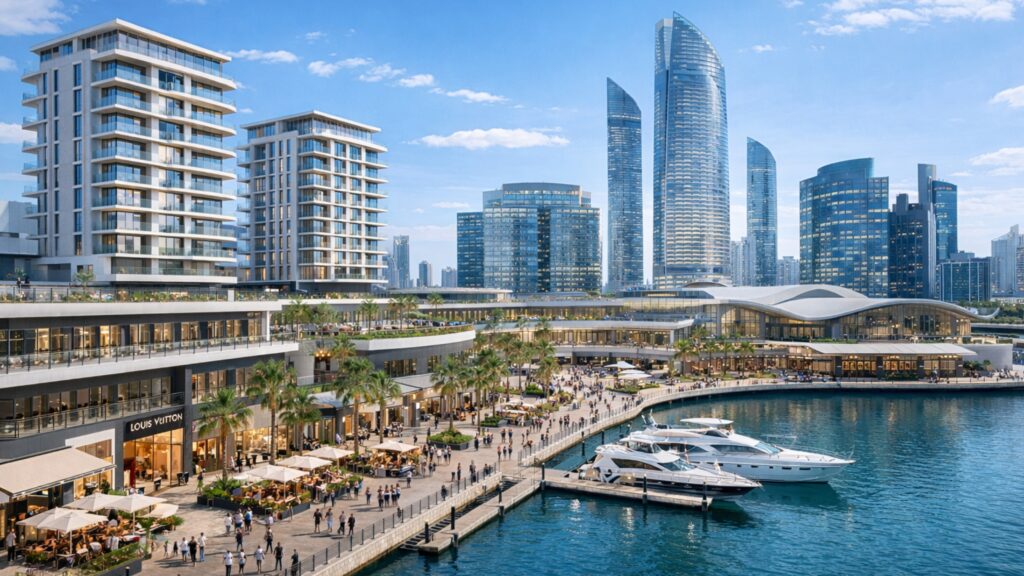
Here’s what I’m observing in the market: Al Maryah Island represents the pinnacle of mixed-use development strategy in Abu Dhabi.
Al Maryah Island integrates 3,000+ residential units with 1.5 million+ square feet of commercial office space (including major corporate headquarters). The development is anchored by world-class dining, luxury shopping, and financial district offices. Mubadala and Aldar announced a landmark AED 60+ billion expansion in December 2025.
The Results:
•Residential properties command 20-25% premiums over comparable single-use properties
•Residential appreciation: 8-14% annually (2026 forecast)
•Residential rental yields: 6.8-8% (based on 2026 market data)
•Commercial office yields: 6-9%
•Retail yields: 8-12%
For investors, Al Maryah Island demonstrates the power of mixed-use integration. A single property generates multiple revenue streams while appreciating at rates competitive with market average.
Investment Strategy: Positioning for the Mixed-Use Development Wave
For investors looking to capitalize on Abu Dhabi’s mixed-use development trend in 2026, I recommend a strategic approach:
Tier 1: Premium Mixed-Use Strategy (Stability & Proven Returns)
Focus on established mixed-use developments like Al Maryah Island, Saadiyat Island, and Yas Island. These developments have proven mixed-use models with strong commercial and retail anchors. Entry prices are elevated, but the stability and multiple revenue streams are unmatched. Appreciation potential is 8-14% annually, with combined residential + commercial/retail yields of 13-20% (depending on property type and lease structure). This tier is ideal for investors prioritizing capital preservation, consistent returns, and multiple income streams.
Tier 2: Emerging Mixed-Use Strategy (Growth Opportunity)
Consider properties in emerging mixed-use developments like Al Raha Beach and newer phases of established communities. These developments offer strong mixed-use models with more attractive entry pricing than Tier 1. Appreciation potential is 8-12% annually, with combined yields of 12-18%. This tier balances growth potential with proven mixed-use integration models.
Tier 3: Commercial/Retail in Mixed-Use (Yield Optimization)
For yield-focused investors, commercial office and retail spaces in mixed-use developments offer competitive yields (6-12%) compared to residential-only properties (6.8-8%). These spaces provide stable, predictable income with strong tenant demand. This tier is ideal for investors prioritizing current income over capital appreciation. Critical Investment Rule: Prioritize mixed-use developments with strong commercial and retail anchors. Developments without proven commercial tenancy or retail demand offer limited mixed-use benefits. Always verify the commercial and retail occupancy rates before investing.
The Intangible Asset: Lifestyle Integration and Community Value
Here’s what investors often overlook: mixed-use developments create genuine communities, not just residential clusters.
When you invest in a mixed-use development, you’re investing in a lifestyle ecosystem. Residents work, shop, dine, and socialize within the same development. This creates genuine community value that translates into stronger rental demand and superior appreciation.
I’m advising clients that mixed-use developments will become increasingly valuable as Abu Dhabi’s market matures. Investors will increasingly pay premiums for the convenience, lifestyle integration, and multiple revenue streams that mixed-use developments provide.
The future of Abu Dhabi’s real estate is mixed-use. Properties positioned in integrated developments are expected to outperform single-use properties by 2-4% annually over the long term based on current market trends.
Conclusion: Mixed-Use Development as a Structural Value Driver
Abu Dhabi’s real estate market is increasingly rewarding investors who understand mixed-use development as a primary value driver. Properties in integrated developments command measurable premiums, appreciate consistently, and generate multiple revenue streams. This creates a clear investment opportunity: prioritize properties in mixed-use developments that offer strong commercial and retail anchors, proven tenant demand, and integrated lifestyle amenities. The mixed-use model is structural—it will persist and strengthen as Abu Dhabi’s population grows and urban density increases.
For investors seeking to build wealth through strategic mixed-use positioning, Abu Dhabi’s development landscape offers a clear roadmap. Tier 1 developments offer stability and proven returns. Tier 2 developments offer emerging opportunities. Tier 3 (commercial/retail) offers yield optimization for income-focused investors. The key to successful real estate investment is understanding that mixed-use development isn’t just about convenience—it’s about revenue diversification, community value, and future-proofing your investment. Properties positioned in integrated developments create value through multiple appreciation drivers and stable, diversified income streams.
For professional guidance on mixed-use development selection and property positioning strategies, visit aymansadieh.com. I’m actively advising investors on properties in Abu Dhabi’s leading mixed-use developments positioned to capitalize on the mixed-use development advantage.
A mixed-use development integrates residential, commercial office, and retail spaces within a single development or connected complex. Residents can live, work, and shop within the same community. Examples in Abu Dhabi include Al Maryah Island, Saadiyat Island, and Yas Island.
Mixed-use residential properties command 15-25% premiums over comparable single-use residential properties. The premium varies based on the strength of commercial and retail anchors. Properties in Al Maryah Island command 20-25% premiums, while properties in emerging mixed-use developments command 15-20% premiums.
Residential properties generate rental income (6.8-8% yields based on 2026 data), commercial office spaces generate lease income (6-9% yields), and retail spaces generate tenant income (8-12% yields). A diversified portfolio across all three generates combined yields of 13-20%. For mixed-use revenue optimization, visit aymansadieh.com.
Prioritize established mixed-use developments with proven commercial and retail anchors: Al Maryah Island (premium tier), Saadiyat Island (premium tier), Yas Island (premium tier), and Al Raha Beach (emerging tier). Verify commercial and retail occupancy rates before investing. For development-specific recommendations, visit aymansadieh.com.
Mixed-use developments reduce risk through revenue diversification. If residential demand weakens, commercial and retail income remains stable. This creates occupancy stability (80-90% even during market adjustments) compared to single-use residential (75-85% during downturns). For risk management strategy, visit aymansadieh.com.