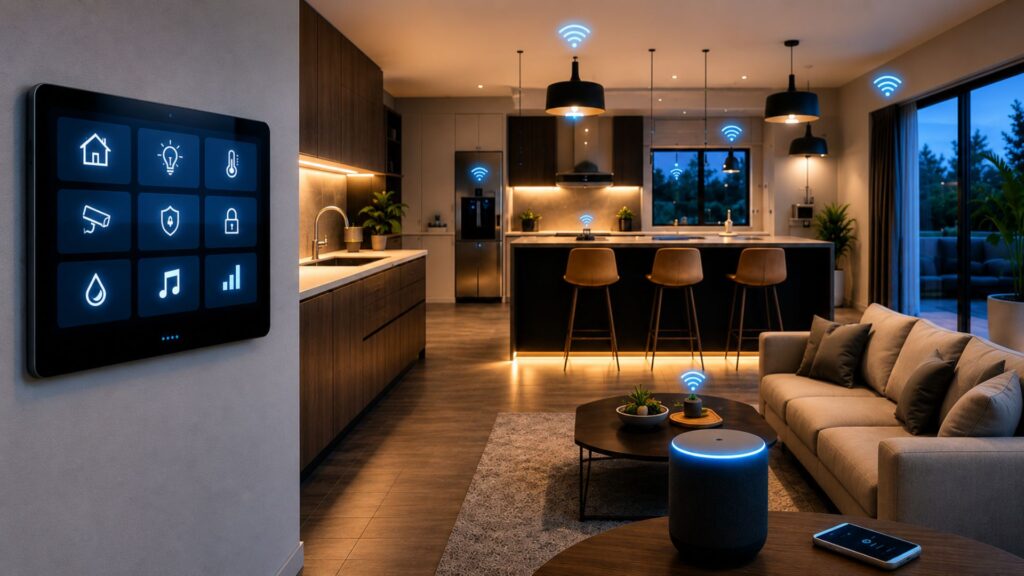
For a decade, “smart home” meant a home that follows instructions. Press a button, a scene plays. Set a schedule, the lights dim at 8pm. That definition has quietly expired. Features once marketed as premium upgrades, voice control, remote security, app-based climate control, are now baseline expectations in new Abu Dhabi developments, and buyers evaluating a property in 2026 need to recalibrate what “extra” actually means before they let a sales brochure’s smart home checklist influence their decision.
The shift is structural, not cosmetic. A smart building connects its core systems, lighting, HVAC, access control, fire, lifts, water, to a software layer that tracks, manages, and optimises them. In a conventional building, these systems operate separately: a problem with the HVAC system gets detected only when someone complains, and the utility bill is checked monthly to monitor energy use. In a smart building, all of that data flows into a single connected system. What used to differentiate a premium address now defines the entry-level expectation.
What’s Now Considered Standard
The baseline has moved considerably faster than most buyers realise. Developers across Abu Dhabi are now integrating smart technologies as a matter of course rather than as an optional upgrade, providing safety, security, and convenience as a package rather than a premium tier. Voice-activated systems for lighting, climate, and entertainment control are now standard across most new mid-to-premium developments. Remote security monitoring, allowing residents to view entry points and receive alerts from anywhere via a mobile app, has become an assumed feature rather than a selling point.
Smart temperature control, where residents can adjust and schedule climate settings remotely, is now baseline across nearly every new launch. App-based building management, covering visitor access, maintenance requests, community amenity bookings, and utility monitoring through a single resident app, has become the default operational model for new communities rather than a differentiator worth highlighting in marketing materials.
| Feature | 2020 Positioning | 2026 Positioning |
| Voice-activated lighting and climate | Premium upgrade | Standard inclusion |
| Remote security monitoring via app | Luxury add-on | Baseline expectation |
| App-based smart temperature control | Optional package | Standard inclusion |
| Resident building management app | Rare, high-end only | Default operational model |
| Smart door locks and access control | Premium security tier | Standard in new developments |
For buyers comparing new launches, the presence of these features in a sales presentation is no longer meaningful information. Their absence, however, is now a genuine red flag about how current a development’s specification actually is.
Why This Shift Happened
The transition from luxury feature to baseline expectation follows a pattern seen in every major technology adoption cycle in real estate. As more developments across Abu Dhabi and the wider UAE include these systems as standard, they stop functioning as differentiators and become assumed minimums that buyers expect regardless of price point. This mirrors the broader UAE market: developers are now incorporating smart home technology into new residential projects as a core offering rather than an optional upgrade, providing app-controlled lighting and climate, remote access, and energy consumption monitoring as part of the base specification.
Government-level infrastructure has accelerated this shift directly. Abu Dhabi’s Masdar City stands as an already fully IoT-connected district, demonstrating what citywide smart infrastructure delivery looks like at scale, while utility providers across the UAE continue expanding smart grid integration that makes app-based energy monitoring technically straightforward for any new development to include. As this underlying infrastructure becomes ubiquitous, the marginal cost for developers to include smart features at the building level drops significantly, removing the economic barrier that once kept these features in the premium tier exclusively.
Developer competition has compounded this effect. Once one major Abu Dhabi developer includes app-based building management and remote security as standard in a new launch, competing developers cannot credibly market a comparable community without matching that baseline. The result is a rapid, market-wide recalibration of what “standard” actually means, occurring largely within the past 18 to 24 months.
What Buyers Should Actually Look For Now
With voice control, remote security, and app-based management no longer meaningful differentiators, the genuinely valuable question for 2026 buyers has shifted to a different category of feature entirely: predictive, AI-integrated systems versus reactive, rule-based automation.
The distinction is best understood as the difference between a smart home and what industry specialists now describe as an intelligent home. A smart home executes instructions faithfully: press a button, a scene plays. An intelligent home forms models of its residents, the climate, its own energy consumption, and potential threats, then makes decisions inside those models without waiting for a command. Concretely, this means AI-driven HVAC systems that combine weather forecasts, occupancy schedules, thermal models of the home, and utility tariff windows to minimise both cost and discomfort automatically, rather than simply allowing a resident to adjust a thermostat remotely.
Genuinely differentiating features in 2026 include AI-integrated building management systems that learn occupancy patterns rather than simply executing fixed schedules, energy efficiency systems that actively optimise consumption against real-time utility tariff structures rather than passively reporting usage after the fact, and security systems using predictive threat detection rather than basic camera-and-alert functionality. Notably, Arabic-language voice AI has become a genuine market differentiator in the UAE specifically, with custom assistants now understanding conversational Arabic at near-human fluency, a capability that matters considerably in a market where English-only voice control was previously the unquestioned default.
For buyers evaluating Trusted VIP property broker Abu Dhabi guidance on which specific 2026 developments offer genuinely advanced smart integration rather than baseline features rebranded as premium, this distinction between reactive and predictive systems is the single most useful filter available. Aldar’s confirmed partnership with PureHealth, announced in July 2026, illustrates where this category is heading: smart beds and contactless smart mirrors offering real-time health monitoring are being integrated directly into future Aldar communities, moving well beyond climate and lighting control into genuinely predictive, health-integrated living environments.
The Resale and Rental Impact
The practical financial consequence of this shift is one that buyers of older developments need to weigh carefully. Resale values of IoT-enabled units are recorded as 8 to 12% higher than comparable non-connected units within the same building, based on documented transaction records analysed across UAE residential markets. IoT connectivity has become a prerequisite during lease negotiations for premium commercial and residential tenants across the UAE, a pattern increasingly mirrored in Abu Dhabi’s competitive rental market as tenant expectations rise in step with what new developments now offer as standard.
This creates a genuine competitive risk for owners of older Abu Dhabi developments that predate the current baseline. A property built five to seven years ago, marketed at the time as offering premium smart features, may now compete directly against newer buildings where those same features are simply the entry-level specification, at a comparable or even lower price point. For landlords and resale sellers, retrofitting basic smart infrastructure, app-based access control, remote climate management, and smart security, has moved from a nice-to-have renovation to a genuinely material factor in maintaining competitive positioning against newer stock entering the market.
For buyers purchasing with a long-term hold in mind, this dynamic works in reverse: securing a unit in a development that already offers genuinely advanced, AI-integrated systems today provides a longer runway before that property’s specification becomes the market baseline that everything else needs to catch up to. For a detailed comparison of which current Abu Dhabi launches offer genuinely future-proofed smart infrastructure versus baseline features, our team at Abu Dhabi’s leading real estate advisory service provides development-by-development technical guidance.
Conclusion: Smart Home Literacy Is Now Essential Buyer Knowledge
The shift from smart home as luxury feature to smart home as baseline expectation happened quickly, and many buyers evaluating Abu Dhabi property in 2026 are still comparing developments using a mental checklist that no longer reflects the market. Voice control, remote security, and app-based management are no longer meaningful differentiators; they are simply what a competent 2026 development should include. Understanding the difference between reactive automation and genuinely predictive, AI-integrated systems, and factoring smart infrastructure into resale and rental competitiveness, is no longer a niche technical interest. It is now essential buyer knowledge, on par with understanding payment plans and freehold zones.
Voice-activated lighting and climate control, remote security monitoring via mobile app, app-based smart temperature control, and resident building management apps covering visitor access and amenity bookings are now standard baseline features across most new mid-to-premium Abu Dhabi developments, no longer marketed as premium upgrades. For guidance on abu dhabi real estate investment advisor services covering smart home specifications across current launches, contact our team.
A smart home executes instructions faithfully, such as a voice command dimming lights on schedule. An intelligent home forms predictive models of residents, climate, energy consumption, and potential threats, then makes autonomous decisions within those models without waiting for a command, such as AI-driven HVAC pre-cooling a bedroom based on learned occupancy patterns and real-time utility tariffs. This distinction is now the genuine differentiator between developments in 2026.
Yes, measurably. Resale values of IoT-enabled units are recorded as 8 to 12% higher than comparable non-connected units within the same building, based on documented UAE transaction records. IoT connectivity has also become a prerequisite in premium lease negotiations, making smart infrastructure a genuine factor in both resale and rental competitiveness rather than a cosmetic feature.
It depends on your investment horizon. Older developments marketed with premium smart features five to seven years ago may now compete against newer buildings where those same features are baseline, at similar or lower price points. This is a genuine competitive risk for resale and rental positioning. For a comparison of Abu Dhabi’s current property market, our advisory team provides development-specific technical assessments.
Aldar’s July 2026 partnership with PureHealth is a clear signal of the next frontier, integrating smart beds, contactless health-monitoring smart mirrors, and advanced air quality systems directly into future community design, moving beyond climate and lighting automation into predictive, health-integrated living environments. Buyers evaluating long-term positioning should track which developers are moving toward this AI-integrated, predictive category rather than simply offering baseline connected features. For a best real estate consultant abu dhabi assessment of which developments offer genuinely advanced smart integration, speak with our team.