
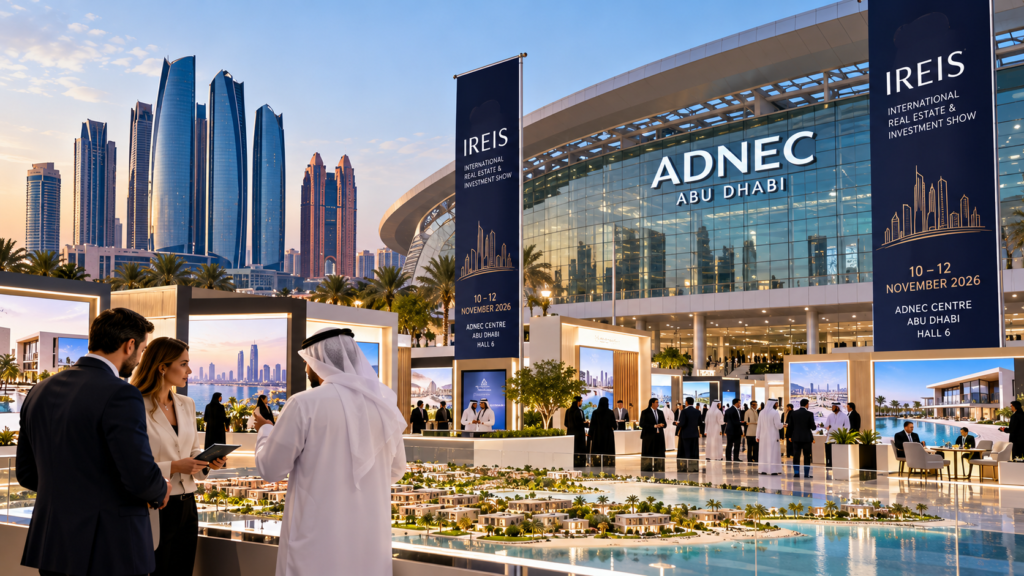
IREIS 2026 Returns to Abu Dhabi: My Perspective on What Property Investors Should Watch at ADNEC
Abu Dhabi will welcome the International Real Estate & Investment Show, IREIS 2026, back to ADNEC Centre from 10 to 12 November 2026.
The 15th edition will take place in Hall 6 and is scheduled to run from 10:00am to 8:00pm on each of the three days. Unlike a purely industry-focused trade exhibition, IREIS is specifically positioned around investors, property buyers and end users, giving visitors the opportunity to meet developers, property advisers and other market participants directly.
From my perspective as an Abu Dhabi property adviser, that is what makes an event like IREIS useful. The value is not simply that many properties are displayed in one place. The real advantage is being able to compare several opportunities side by side and understand how each one fits into the wider Abu Dhabi property market.
IREIS 2026 also arrives at an interesting point for Abu Dhabi real estate. Transaction activity has expanded significantly, off-plan property continues to account for a major share of residential sales, and international participation in the market has grown.
For buyers who want to prepare before attending, I regularly cover new launches and investment opportunities through my latest Abu Dhabi property projects.
What Is IREIS 2026?
IREIS stands for the International Real Estate & Investment Show.
The 2026 exhibition will bring together local developers, international property companies, brokers, consultants, investors and end users at ADNEC Centre Abu Dhabi. The three-day event is expected to highlight real estate investment opportunities from the Middle East, Europe and Asia-Pacific markets.
What makes IREIS different from some industry conferences is its focus on the actual property buyer. Investors can speak directly with companies presenting developments, ask questions about individual projects and compare different investment markets without having to arrange separate meetings over several weeks.
I see the exhibition primarily as a research and comparison opportunity. A buyer does not have to enter ADNEC with the intention of purchasing immediately. It can be more valuable to leave the exhibition with a much clearer understanding of which locations, developers and property types deserve further consideration.
Why IREIS 2026 Matters for Abu Dhabi Property Buyers
Property exhibitions can be useful, but I do not think buyers should treat them simply as sales events.
Their real value is comparison.
During a normal property search, a buyer may receive information about one development today, another next week and a third several weeks later. By that point, it becomes difficult to compare the opportunities objectively because the prices, payment structures and property details are being considered at different times.
IREIS brings multiple real estate opportunities into the same environment.
That allows an investor to compare the quality of different locations, understand the reputation and track record of the developers involved and look carefully at what is actually being offered for the starting price.
The comparison should then go deeper.
A buyer needs to understand how much is payable during construction, when the property is expected to be handed over and whether the available units are actually the strongest positions within the development.
The wider masterplan is equally important. A project can look attractive on its own, but the long-term value may depend heavily on the surrounding roads, retail, landscaping, schools, leisure facilities and future residential supply.
I would also want to understand the less visible costs. Expected service charges, financing terms and ownership structure can significantly affect the total cost of holding a property.
For investors, I would then consider the future tenant and resale market. If the property is purchased off-plan, the ability to resell before handover and the conditions attached to that resale can also become important.
For me, this is the right way to use IREIS. The goal should not be to identify the project with the biggest exhibition promotion. It should be to understand which opportunity makes the most sense for the buyer’s budget, timeframe and long-term objective.
IREIS Arrives During a Strong Period for Abu Dhabi Real Estate
The timing of IREIS 2026 is particularly relevant because Abu Dhabi’s property market has recorded substantial activity this year.
Abu Dhabi recorded AED 117 billion in total real estate transactions during the first half of 2026, representing a strong increase in transaction value compared with the same period a year earlier.
Sales transactions accounted for AED 86.1 billion across 16,838 transactions during the same six-month period. Foreign direct investment reached AED 13.8 billion, while non-resident investors from 116 nationalities participated in the market.
The residential market also remains heavily influenced by off-plan property. Residential unit sales reached AED 70.4 billion during H1 2026, with off-plan transactions accounting for 89% of residential sales value.
For me, these figures provide important context.
They show that IREIS is not returning to a quiet market. It is taking place while Abu Dhabi is attracting significant capital, launching new communities and seeing strong interest in new residential projects.
At the same time, strong market activity should never be interpreted as meaning every new project is automatically a strong investment.
When transaction volumes rise and launches become more frequent, comparison becomes even more important.
Why International Buyers Should Pay Attention to IREIS 2026
Abu Dhabi’s property market is becoming increasingly international.
The fact that investors from 116 nationalities participated as non-resident investors during the first half of 2026 illustrates how broad that international interest has become.
For an overseas investor, IREIS offers something particularly useful: the chance to understand several parts of the market during one visit.
International buyers often begin by asking which project they should purchase.
I normally prefer to start with a different question: what does the buyer actually want the property to achieve?
Someone looking for a permanent family residence has very different requirements from an investor focused on rental income.
A buyer seeking a second home may prioritise airport access, beaches, hospitality and property management. Someone investing for long-term capital growth may be more interested in an emerging masterplan, future infrastructure and scarcity.
Once that objective is clear, the choice of community becomes much easier.
For buyers specifically interested in premium new developments, my Abu Dhabi luxury off-plan property guide explains how I assess off-plan opportunities beyond the marketing material.
Developer Quality Matters More Than the Marketing
One of the first things I look at in an off-plan property is the developer itself.
A strong launch campaign, impressive renders and an attractive sales centre can generate interest, but they do not tell me whether a company consistently delivers the quality promised at launch.
I prefer to study what the developer has already completed.
I want to know how previous projects look after residents have moved in, whether delivery timelines have generally been respected and how the community is maintained after handover.
I would also look at how much the developer currently has under construction. A large pipeline can demonstrate scale, but buyers should still understand how each project fits within that pipeline.
For an off-plan purchase, the project itself should also be checked carefully. Registration, purchaser-fund arrangements, construction milestones, payment obligations and handover conditions all matter.
A strong payment plan is useful, but it only becomes meaningful when it is attached to a credible development and a developer capable of delivering it.
Location Must Be Evaluated Beyond the Map Pin
Location is another area where buyers can easily oversimplify the decision.
A property being located on Yas Island, Saadiyat Island, Hudayriyat Island or another well-known destination does not automatically make every unit within that community equally attractive.
Two properties in the same development can have very different long-term appeal.
I would consider how easily residents can access the property, what schools and healthcare facilities are nearby and how the surrounding retail and lifestyle infrastructure will develop.
Then I would look at the future.
If several thousand new residential units are planned nearby, that future supply may affect both rental competition and resale liquidity.
On the other hand, planned infrastructure, hotels, cultural attractions or retail can strengthen a location as the community matures.
For a villa, I would consider privacy, orientation, road exposure, landscaping and proximity to parks or the waterfront.
For an apartment, I would study the floor, view, neighbouring plots and whether future construction could change the outlook.
This becomes especially important in emerging Abu Dhabi destinations, where the completed masterplan may eventually look very different from the area a buyer sees today.
A Flexible Payment Plan Does Not Automatically Mean a Good Investment
Payment plans are often one of the first features promoted at an off-plan launch.
A 50/50, 60/40 or post-handover structure may make the purchase easier to manage from a cash-flow perspective.
But I would never judge a property primarily by its payment schedule.
The more important question is whether the property itself is correctly priced.
A very flexible payment plan attached to an overpriced unit can still result in a weak investment.
I prefer to compare the asking price with competing developments, completed properties in the same area and the actual quality of the product.
I would also consider the price per square foot, but not in isolation. A waterfront villa, branded residence or highly positioned apartment may reasonably trade at a different rate from a standard unit nearby.
The payment plan should support the investment case.
It should not become the investment case.
Handover Timing Can Change the Investment Strategy
The expected completion date deserves more attention than it often receives.
An investor buying a project scheduled for handover next year is taking a very different position from someone buying into a masterplan that may take four or five years to mature.
A longer construction period can provide more time to spread payments, but it also means the investor must wait longer before the property can potentially produce rental income.
Market conditions may also change significantly during that period.
For that reason, I consider the handover date together with the wider community timeline.
If the property is scheduled for completion in 2030 but the surrounding schools, retail and public spaces are not expected until later, the investor needs to understand that difference.
The best scenario is when the property and the wider destination mature in a way that supports each other.
Rental Demand Should Be Based on a Real Tenant Profile
When a project is presented as an investment opportunity, rental yield is often part of the conversation.
But before discussing a percentage, I want to know who is actually expected to rent the property.
A one-bedroom apartment near a major business district may appeal to professionals.
A townhouse close to schools and family amenities may attract long-term family tenants.
A premium waterfront residence may appeal to executives or international residents, but the potential tenant pool could be narrower.
The investor should therefore understand who the future tenant is likely to be, why that tenant would select this particular project and what other properties will compete for the same tenant.
Only after answering those questions does an estimated rental return become meaningful.
Resale Liquidity Is Just as Important as Entry Price
Investors naturally spend a lot of time thinking about how they enter a market.
I believe they should spend equal time thinking about how they might eventually leave it.
A property can look attractive at launch but still be difficult to resell if there is too much competing inventory or if the property type appeals to a very small group of buyers.
For off-plan property, I would also check the developer’s resale or assignment rules.
Some projects require a certain percentage of the purchase price to be paid before the property can be transferred.
If an investor expects to sell before handover, those terms should be understood before the initial purchase, not when the investor is already trying to exit.
The Exact Unit Can Matter as Much as the Project
One of the most common mistakes I see buyers make is choosing the project first and treating all remaining inventory as roughly equal.
It rarely works that way.
Inside the same development, the floor, orientation, view, privacy and layout can create meaningful differences between units.
For apartments, a higher floor may offer a better view but could also command a substantial premium. That premium should be justified.
A corner unit may offer additional windows and privacy.
Another apartment may face future construction that is not immediately obvious from the sales brochure.
For villas, plot shape, road position, proximity to the entrance and distance from neighbouring properties can make an equally large difference.
This is why I prefer selecting a specific property rather than simply recommending a project name.
Abu Dhabi’s Main Investment Areas Serve Different Buyers
IREIS visitors interested in Abu Dhabi will encounter a market that is increasingly diverse.
Saadiyat Island is strongly associated with beaches, cultural institutions, luxury hospitality and premium residences. It can appeal to buyers seeking an internationally recognised luxury address.
Yas Island offers a different proposition, combining established residential communities with entertainment, retail, leisure and hospitality. It can work particularly well for families and lifestyle-driven investors.
Jubail Island has a more nature-led identity, with mangroves, lower-density villa communities and greater emphasis on privacy.
Hudayriyat Island represents one of Abu Dhabi’s major emerging residential stories, particularly around large villas, sports, wellness and long-term masterplan development.
Al Reem Island remains an important apartment market close to central Abu Dhabi, while Al Maryah Island combines premium urban living with finance, retail, healthcare and hospitality.
There is no single community I would recommend to every buyer.
The right location depends on how the property will be used and how long the buyer expects to hold it.
Comparing Abu Dhabi With International Property at IREIS
IREIS is not limited to Abu Dhabi or even to the UAE.
The exhibition is expected to feature opportunities from the Middle East, Europe and Asia-Pacific, which gives UAE-based investors the opportunity to consider international diversification as well.
That comparison can be useful, but overseas property needs to be evaluated carefully.
I would never compare two international properties purely by looking at their advertised rental yields.
A property’s true investment performance can be affected by local taxation, property management, maintenance, financing costs, vacancies and currency movements.
Ownership laws and resale costs also differ substantially from one market to another.
An advertised return in London, Europe or Asia therefore cannot automatically be compared with the same advertised percentage in Abu Dhabi.
The comparison should be based on realistic net outcomes and the risks involved in achieving them.
What First-Time Buyers Should Do at IREIS
For someone purchasing property for the first time, IREIS can be an excellent place to learn.
My advice would be to use the exhibition to ask questions rather than feeling pressure to make a decision immediately.
Speak to developers.
Understand how different payment plans work.
Ask what has already been constructed.
Ask when the surrounding amenities are expected to open.
Understand the additional costs beyond the property price.
Then take the information away and compare it.
An exhibition offer should still make sense once the buyer leaves the exhibition hall.
If the property only feels attractive because a promotion expires at the end of the day, I would want to understand the underlying investment much more carefully before committing.
Due Diligence Should Continue Even Inside an Exhibition
A major property exhibition creates convenience, but it does not remove the need for due diligence.
Before reserving a property, I would want to confirm the exact unit being purchased rather than relying on a generic floor plan.
I would verify the total purchase price and understand every stage of the payment schedule.
I would check the expected handover, ownership eligibility and any restrictions affecting resale.
Service charges should also be considered because they directly affect the cost of ownership and, for investors, the net rental return.
If financing is involved, the buyer should understand how much the bank may finance, when the finance becomes available and what personal contribution is required.
For off-plan property, project registration, payment arrangements and the developer’s obligations should be understood before the reservation becomes a major financial commitment.
Why I Believe Professional Comparison Matters
Having many developers inside one exhibition hall is convenient.
It can also be overwhelming.
Every sales team is understandably presenting the strongest case for its own project.
My role as an adviser is different.
I am interested in how that project compares with the alternatives.
If one development has a better payment plan but another has a stronger location, we need to determine which factor matters more for that particular buyer.
If one property has a lower entry price but substantially more future supply, that should be part of the decision.
If a premium unit carries a large price difference because of its view or plot position, we should determine whether the scarcity justifies that premium.
That independent comparison is often more valuable than simply being shown more properties.
Visitors preparing for the exhibition can also review my latest Abu Dhabi real estate projects to understand some of the opportunities currently available across the capital.
Should You Buy Property at IREIS 2026?
IREIS can certainly be a place where a buyer discovers the right property.
But I do not believe anyone should purchase simply because they are physically at an exhibition.
The investment should still work after the marketing, promotional offer and exhibition atmosphere are removed from the decision.
I would want to be comfortable with the location, developer, exact property, price and payment obligations.
I would want a clear understanding of the handover timeline, future supply and expected ownership costs.
For an investment property, I would also want a realistic idea of who will eventually rent or buy it.
If all of those elements support the decision, then an exhibition can provide an efficient route to securing a suitable property.
If they do not, walking away is also a good investment decision.
My Perspective on IREIS 2026
I see IREIS 2026 as another sign of how Abu Dhabi’s real estate market is becoming more sophisticated, international and investment-focused.
The exhibition returns at a time when the emirate has recorded strong transaction activity, international participation is increasing and new residential communities continue to expand the range of opportunities available to buyers.
But I would not measure a successful visit to IREIS by the number of projects someone sees or how many reservation forms they sign.
For me, a successful visit is one that gives the buyer clarity.
If you leave ADNEC understanding which community fits your objectives, which property type is appropriate, what price represents reasonable value and which risks need further investigation, then the exhibition has served its purpose.
The strongest property decisions are rarely based on a single headline.
They are made by understanding how the developer, property, location, financing, future supply and buyer’s own objectives fit together.
That is the approach I recommend for IREIS 2026, and it is the same approach I use when advising clients considering property across Abu Dhabi.
IREIS 2026 will take place from 10 to 12 November 2026 at ADNEC Centre Abu Dhabi. The event is scheduled in Hall 6 and will run from 10:00am to 8:00pm on each day.
IREIS is designed around property investors, buyers and end users as well as real estate professionals. I believe it is particularly useful for people who want to compare several developers or investment markets during one visit rather than evaluating opportunities individually over a longer period.
Yes. The exhibition includes local and international property opportunities, while Abu Dhabi itself is attracting buyers from an increasingly diverse range of countries. International buyers considering the UAE market can review my Abu Dhabi luxury property and off-plan guidance before attending so they have a clearer basis for comparison.
Only after completing the same checks you would make outside an exhibition. I would review the exact property, developer, price, payment structure, handover timeline, ownership eligibility, future supply, service charges and resale conditions before committing. A short-term exhibition promotion should support a good property decision rather than become the main reason for buying.
Buyers who want to understand current inventory before attending the exhibition can explore off-plan properties in Abu Dhabi through NAS Luxury Real Estate. Comparing available projects beforehand can make it easier to recognise whether an exhibition opportunity is genuinely competitive.