A beautiful sea view can make a property feel exceptional. It can influence the price, the lifestyle experience and the decision to purchase.
But when I evaluate a waterfront property in Abu Dhabi, I look beyond what is visible from the balcony today.
I want to understand what will be visible five or ten years from now.
There is a significant difference between buying a property that currently has a sea view and buying one where the view benefits from documented protection against future obstruction.
This distinction becomes particularly important when purchasing off-plan apartments, beachfront villas or luxury residences in communities that are still under development.
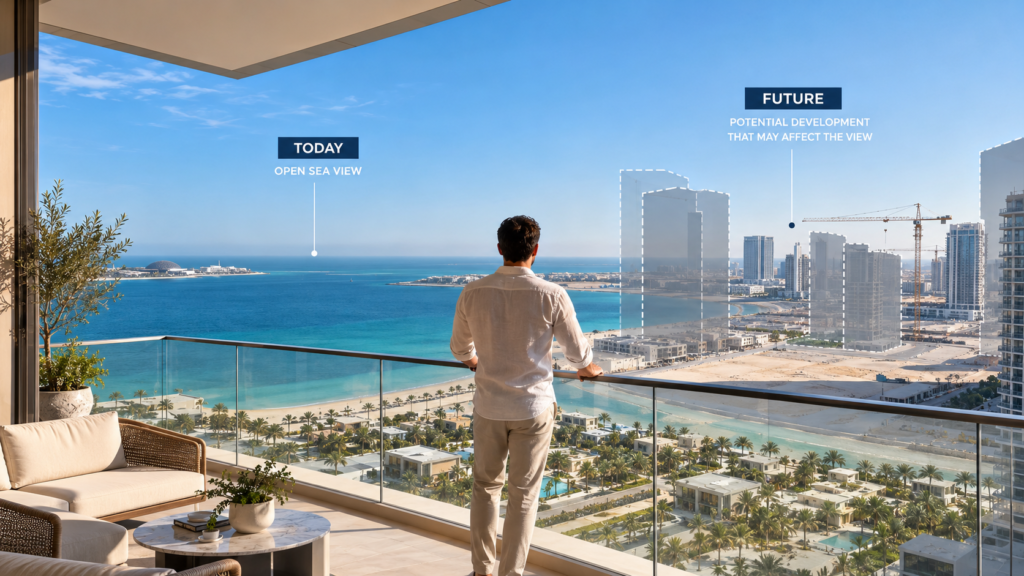
A property may offer an impressive panoramic view during its launch, yet that same outlook could change once neighbouring plots, residential towers or future construction phases are completed.
The real question is not simply whether the property has a sea view. It is whether the buyer understands how that view could change.
A Sea View Is Not Always a Protected Sea View
In real estate marketing, descriptions such as full sea view, panoramic waterfront view and uninterrupted ocean views can sound reassuring.
However, these descriptions primarily communicate what the property is intended to overlook. They do not necessarily establish that the view will remain unobstructed.
A sea view is the visible outlook towards the water from a property.
A protected sea view is different. It involves identifiable planning controls or legal restrictions intended to preserve a particular view corridor.
Such protection might involve building-height limitations, development setbacks, designated open spaces or restrictions on where neighbouring buildings can be constructed.
Even then, buyers should not assume the protection is permanent or absolute. Its scope depends on the applicable planning documents, legal arrangements and whether those controls can be amended.
In Abu Dhabi, the Department of Municipalities and Transport’s detailed masterplan guidance includes provisions for protecting significant view corridors through the management of building locations and forms. Multiple Buildings
That does not mean every waterfront property benefits from those provisions.
The important step is determining what applies to the specific unit, plot and development.
Not All Sea Views Offer the Same Experience
When comparing waterfront properties, I distinguish between several types of views. Each has different characteristics, and some carry greater potential for future obstruction.
Direct Sea View
A direct sea view means the water is positioned ahead of the property rather than primarily to one side.
In an apartment, this might mean seeing the coastline directly from the living room and balcony. In a villa, it could mean the main living spaces and outdoor terrace face the waterfront.
A direct view can be highly desirable, but it should not be confused with a protected view.
An apartment may face the sea directly today while overlooking an empty plot that is eligible for future development.
Partial Sea View
A partial sea view means only a portion of the water is visible.
Neighbouring buildings, architectural structures or landscaping may interrupt the outlook.
The distinction matters because two apartments in the same development may both be advertised as sea-view units despite offering substantially different visual experiences.
A narrow view of the water between buildings is not equivalent to a broad waterfront panorama.
Oblique or Side Sea View
An oblique sea view is visible from an angle rather than directly ahead.
The sea might be visible from one side of the balcony or through windows positioned diagonally towards the coastline.
This is particularly common in residential towers where apartments have different orientations.
For buyers paying a premium for a sea view, I recommend understanding whether the water is visible from the principal living areas or only from a particular viewing angle.
Upper-Floor Sea View
Higher floors often provide wider sightlines over surrounding buildings.
But elevation alone does not protect a view.
An apartment on the 25th floor might overlook an existing low-rise community. If a neighbouring plot is later developed with a taller tower, the original outlook could be significantly reduced.
The actual elevation of the apartment matters more than the advertised floor number.
Temporary Sea View
A temporary sea view is perhaps the most important category for off-plan buyers to understand.
Imagine an apartment facing the coastline across a large, vacant parcel of land.
Today, the view appears completely open.
The sales presentation may show a clear horizon, uninterrupted sunlight and water extending across the entire balcony outlook.
But if the vacant land is designated for future residential development, that view could change considerably.
This is why I never assume that empty land will remain empty.
Protected Sea View
A protected sea view has some form of documented planning or legal protection intended to preserve the outlook.
For example, a designated view corridor might restrict construction within a particular area.
However, a protected view is not necessarily a promise that nothing in the surrounding environment will ever change.
A buyer must establish exactly what is protected, which restrictions apply and whether they are enforceable.
The Empty Plot in Front of Your Apartment May Be the Most Important Detail
Consider two hypothetical waterfront apartments in Abu Dhabi.
Both have similar layouts, floor areas and finishes.
Both currently overlook the sea.
The first apartment faces an undeveloped plot where future construction may be permitted.
The second faces a designated view corridor with documented restrictions on development.
Although the existing views might look almost identical, their exposure to future obstruction could be very different.
The first buyer is purchasing a property with a view that may change.
The second buyer has evidence of restrictions intended to preserve a particular outlook, subject to their legal scope and future planning decisions.
This distinction is especially important in large master-planned developments where land is released in several construction phases.
A project’s first phase may appear open and spacious because neighbouring buildings have not yet been constructed.
Once later phases are completed, the visual character of the community may be very different.
For that reason, I prefer to evaluate the completed masterplan rather than relying solely on what is currently under construction.
Why Future Development Can Change the View After Handover
A property’s outlook can change for several reasons, and not all involve another residential tower being constructed directly in front of it.
Neighbouring Towers and Future Building Heights
The most obvious risk is a new building obstructing the view.
But complete obstruction is not the only concern.
A neighbouring tower might block one side of the coastline, interrupt a panoramic outlook or reduce privacy by introducing balconies directly opposite the property.
Building height, distance, orientation and positioning all influence the eventual impact.
This is why I examine the permitted development parameters of nearby plots whenever the information is available.
Roads, Bridges and Infrastructure
Future roads, elevated structures, bridges and associated infrastructure may change the visual environment surrounding a waterfront property.
A residence might retain its sea view but gain a major road or elevated structure between the building and the water.
The distinction matters because a clear sea view and a peaceful waterfront setting are not necessarily the same thing.
Buyers should understand the surrounding infrastructure plans, particularly in communities undergoing substantial development.
Landscaping and Community Facilities
Landscaping is generally presented as a positive feature of residential developments, and often it is.
However, mature trees, landscaped embankments, pavilions and waterfront facilities can affect sightlines, particularly from lower-floor apartments and villas.
A property that currently overlooks an open landscaped area may eventually face taller vegetation or additional community structures.
The relevant question is how the completed landscape will interact with the property’s elevation and orientation.
Construction Phases and Masterplan Changes
A developer’s initial promotional materials may focus on the first phase rather than the entire development.
Later phases may introduce additional apartment buildings, hospitality developments or community facilities.
Furthermore, masterplans can be subject to revisions and regulatory approvals.
A view that appears unobstructed in an early rendering may not accurately represent the completed development.
I therefore distinguish between conceptual illustrations, proposed plans and the latest approved planning documents.
Why the Masterplan Matters More Than the Rendering
One of the first documents I want to examine when evaluating an off-plan waterfront property is the masterplan.
A rendering is designed to communicate the architectural concept and intended lifestyle.
A masterplan provides the wider planning context.
It helps establish where buildings are positioned, how the surrounding land is intended to be used and how the development may evolve.
The Department of Municipalities and Transport’s published detailed masterplan requirements include information on view corridors, building typologies, land use, plot development parameters and building heights. Multiple Buildings
These are exactly the types of details that can help buyers assess the likelihood of future obstruction.
For luxury property purchases, I pay particular attention to five elements.
The approved masterplan: What is planned for the surrounding community, and does the information include later development phases?
The exact unit orientation: Which direction do the main living spaces, bedrooms and outdoor areas face?
The neighbouring plot boundaries: What land lies between the property and the water, and what development may be permitted there?
The property’s actual elevation: How high is the unit relative to surrounding buildings and future development envelopes?
Available future development information: Are neighbouring towers, infrastructure projects or additional phases already proposed or approved?
Taken together, these details create a more complete understanding of the property than a sea-view label alone.
Why This Matters for Luxury Properties on Saadiyat Island
Saadiyat Island is a useful example of why buyers should distinguish between a prestigious location and the specific characteristics of an individual property.
The island includes different residential environments, from established beachfront villas to luxury apartments, branded residences and emerging residential communities.
A home facing an open coastal stretch may have a very different outlook from a property facing an internal landscaped area, another building or a planned development plot.
Even within one project, the position of individual apartments can influence the width of the view, privacy and exposure to surrounding construction.
For buyers comparing properties on Saadiyat Island, the project name alone is not enough.
I also consider the exact building, unit position, orientation, surrounding plots and available development information.
These are among the factors I examine in my Saadiyat Island luxury property advisory, particularly when comparing beachfront properties, luxury apartments and premium resale opportunities.
The same approach is relevant to waterfront developments across Al Reem Island, Al Raha Beach, Yas Island and Hudayriyat Island.
Each location has different planning characteristics, and it would be misleading to assume every waterfront property carries the same level of view protection.
Does a Protected Sea View Make a Property More Valuable?
A sea view can influence desirability and pricing, particularly within luxury residential developments.
But not all sea views justify the same premium.
A wide, direct waterfront outlook may be more attractive to certain buyers than a limited side view.
Similarly, a property with documented protection against future obstruction may offer greater confidence than a comparable unit facing land that could accommodate new construction.
That confidence can be valuable.
However, there is no universal percentage premium for a protected sea view in Abu Dhabi.
The actual value depends on comparable transactions, the property’s location, the quality of the view, scarcity, privacy and the alternatives available to buyers.
I would never recommend paying an additional amount simply because a brochure describes a view as protected.
I would first examine what the protection means and whether comparable transactions support the premium.
A Sea View Should Be Evaluated as Part of the Property’s Long-Term Value
When evaluating luxury real estate, I consider the view alongside several other factors.
These include the quality of the layout, the surrounding community, building condition, accessibility, service charges and future resale demand.
For example, a property with a spectacular but potentially temporary view may not necessarily be a better purchase than a well-positioned residence with a more modest but lower-risk outlook.
The answer depends on the buyer’s objectives and the prices of the two properties.
This is especially relevant when comparing off-plan projects with completed homes.
With a completed property, buyers can inspect the existing view from the actual residence.
However, even a ready property may face future development on neighbouring land.
In my Abu Dhabi luxury resale property guide, I explain why plot position, orientation, comparable transactions and property-specific characteristics deserve careful examination before purchasing.
The Risk of Paying Today’s Price for Tomorrow’s Uncertain View
One of the concerns I have with certain off-plan buying decisions is the premium attached to features that have not been independently verified.
A buyer may pay more for an apartment because it is marketed as a panoramic sea-view residence.
That premium becomes part of the acquisition cost.
If the view later becomes obstructed, the property may no longer offer the same characteristics that originally justified the higher price.
This does not automatically mean the property will lose value. Broader market appreciation, rental demand and other property characteristics may influence its eventual resale price.
But the buyer may have paid for an advantage that was less secure than expected.
For me, this is a question of investment discipline.
When a substantial part of the asking price depends on the view, the evidence supporting that view should receive equally substantial attention.
What I Would Check Before Buying a Sea-View Property in Abu Dhabi
Before committing to a high-value waterfront residence, I would want to understand the property from three different perspectives.
The View That Exists Today
For a completed property, I would inspect the outlook directly from the main rooms and outdoor spaces.
For an off-plan property, I would request unit-specific information and distinguish between architectural illustrations and verified building specifications.
A generic rendering of the development is not sufficient to establish the exact view from a particular apartment.
The View That Is Currently Planned
I would examine the latest available approved masterplan, surrounding plot information and proposed building heights.
If future development is identified, I would assess how it could affect the unit’s sightlines.
Where information is preliminary or unavailable, I would treat that uncertainty as part of the property’s risk profile.
The View That Is Contractually or Legally Protected
If a developer or seller describes a view as permanently protected, I would want that statement supported by appropriate documentation.
This might involve applicable planning restrictions or contractual commitments.
The documents should be reviewed to establish their exact scope, limitations and enforceability.
A verbal assurance is not a substitute for written evidence.
For substantial purchases, independent legal and technical review may also be appropriate.
Why Better Property Selection Starts Before the Reservation
In luxury real estate, buyers sometimes focus on choosing the best project before comparing the individual units.
I believe the second decision deserves just as much attention as the first.
A prestigious development can contain apartments with very different orientations, views, privacy levels and exposure to future construction.
The most expensive apartment is not automatically the best-positioned one.
Similarly, the highest floor is not necessarily the best investment, and a sea-facing balcony does not guarantee a lasting panoramic outlook.
The right unit should be evaluated in the context of the entire development, not simply the floor plan or marketing presentation.
This is particularly important for international buyers who may be making purchasing decisions remotely.
Understanding the exact unit position, surrounding masterplan and potential future changes can help reduce the risk of buying a property that does not match expectations at handover.
For those researching current launches, my latest Abu Dhabi luxury projects guide provides a starting point for exploring developments before moving into individual property assessments.
My Perspective: The Best View Is the One You Understand Before Buying
After years of working in Abu Dhabi luxury real estate, one principle continues to guide the way I evaluate waterfront properties:
A beautiful view is an attractive feature, but a well-understood property is a better foundation for a purchasing decision.
I do not believe buyers should avoid properties simply because surrounding development may change.
Abu Dhabi is a growing city, and new construction is part of that growth.
What matters is knowing what is planned, identifying what remains uncertain and understanding whether the purchase price reflects those circumstances.
A direct sea view may be exceptional. A partial sea view may still offer excellent lifestyle value. A high-floor apartment may have an impressive outlook.
But none of those descriptions, by themselves, proves that the view will remain unchanged.
Before paying a premium, I would rather examine the masterplan, understand the surrounding plots and verify the available development information than rely on a rendering that shows only the most attractive angle.
Because in luxury real estate, you are not only buying what you can see today.
You are buying a property that must continue to meet your expectations long after the marketing campaign has ended.