
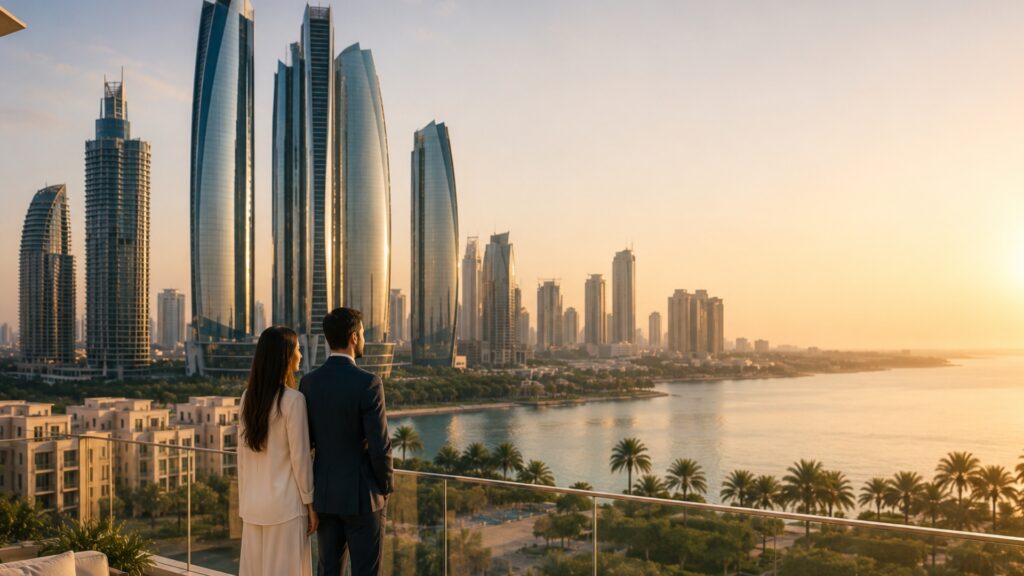
For the better part of five years, the UAE property market belonged unambiguously to sellers. Prices rose, supply fell short of demand, and buyers competed for limited inventory with limited leverage. That dynamic is beginning to shift — and for the first time in years, serious conversations are happening about whether the market has crossed into buyers’ territory.
The honest answer, as of May 2026, is: it depends entirely on which market you are looking at. Dubai’s residential property market has entered its most favourable conditions for buyers in several years, with villa prices stabilising, transaction volumes slowing and sellers showing greater willingness to negotiate, according to industry experts and new market data. Abu Dhabi, by contrast, is telling a meaningfully different story — and understanding that difference is the most important thing any investor can do right now.
Table of Contents
ToggleWhat Has Changed and Why
The shift did not happen in isolation. The UAE residential market is moving into a more balanced phase after a long period of strong growth. Regional and geopolitical uncertainty has become the main barrier to market entry for many buyers, outweighing traditional concerns such as pricing or financing, according to Savills. Near-term activity is expected to remain more deliberate, with softer transaction volumes and tougher negotiation in some segments.
This is a materially different set of headwinds from the ones that typically precede a market correction. The hesitation is not driven by affordability concerns, rising interest rates, or oversupply — it is driven by sentiment. And sentiment-driven pauses, in structurally sound markets, tend to be temporary. The investors who understand this distinction are the ones who position correctly while others wait.
Abu Dhabi: A Different Market Responding Differently
While sales price growth in Dubai’s residential sector slowed to around 9% year-on-year, average prices did not fall and Abu Dhabi’s residential market posted record transaction values in the same period. That parallel performance — Dubai moderating while Abu Dhabi records — is not coincidental. It reflects the structural differences between the two markets that have been building for several years.
Abu Dhabi’s price-per-sqft remains significantly more accessible than Dubai’s. ValuStrat’s Q3 2025 benchmarks placed Abu Dhabi’s citywide weighted-average at AED 1,005 per sqft, compared to AED 1,689 per sqft in Dubai by December 2025. That gap — nearly 40% more affordable on a per-sqft basis — means Abu Dhabi entered the current period of uncertainty from a position of relative value, not stretched valuation. Markets that correct most sharply are those where prices had run furthest ahead of fundamentals. Abu Dhabi had not reached that point.
The ValuStrat Price Index for Abu Dhabi’s freehold residential market rose to 148 points in Q1 2026, with 17.8% annual growth and apartments appreciating 22.7% year-on-year. These are not the numbers of a market softening under pressure — they are the numbers of a market still finding its natural level after years of underperformance relative to its own fundamentals.
What the Experts Are Actually Saying
The nuance in the current expert commentary is important and worth reading carefully. “Structural undersupply across various asset classes, well-established institutional frameworks, and the country’s pivotal role as a destination for international capital have collectively strengthened market fundamentals,” said Matthew Green, head of research at CBRE MENA.
That is not a bearish statement — it is a qualified one. The fundamentals are intact. The uncertainty is external and geopolitical, not internal and structural. A new analysis by property consultancy Cavendish Maxwell warns that geopolitical risk has become “no longer optional, but foundational” for Gulf real estate investors, with events such as regional conflict, sanctions and hydrocarbon price swings capable of substantially altering construction timelines.
For Abu Dhabi specifically, the government’s sovereign backing of its major developers — Aldar’s AED 33.2 billion in total liquidity, Modon’s AED 5 billion Nawayef construction contract awarded in December 2025 — provides a layer of delivery certainty that privately funded developments in other markets simply cannot match. The construction timeline risk that Cavendish Maxwell flags is, in Abu Dhabi’s case, substantially mitigated by the developer profile.
The Long-Term Investor’s Lens
For long-term buyers, experts say the shift represents an opportunity — but only for those willing to be patient. This is precisely the framing that Abu Dhabi rewards. The emirate’s off-plan market has never been designed for short-term flippers — it has been built for buyers with a three-to-five year horizon who are prepared to let the fundamentals do the work.
Those fundamentals remain compelling. Rental occupancy citywide stands at 88.1%. Annual lease price growth reached 5.9% as of Q1 2026. FDI by individuals grew 423% year-on-year in Q1, with buyers from 99 nationalities participating. The supply pipeline is growing at just 3.3% against demand that nearly doubled in transactional volume. None of these numbers have changed because of geopolitical sentiment. They are the bedrock beneath the noise. For investors ready to look past the short-term hesitation and position for where this market is heading, our advisory team is here to help you build a strategy grounded in data, not headlines. Speak with us at Ayman Sadieh.
Conclusion: Buyers Have a Window — But It Is Not Permanent
A buyers’ market, when it appears in a structurally sound destination, is a window — not a new normal. “Despite ongoing geopolitical tensions, the UAE is benefiting from its reputation as a stable, transparent and well-regulated environment for investment. The continued dominance of primary sales also points to long-term confidence in the emirate’s growth and development pipeline,” said Firas Al Msaddi, CEO of fäm Properties.
In Abu Dhabi, that confidence is anchored by sovereign infrastructure investment, a record regulatory upgrade cycle, and a developer landscape dominated by government-backed entities committed to long-term delivery. The current moment of market deliberateness is not a warning signal for Abu Dhabi investors — it is an entry window for those with the conviction to act while others pause.
Not to the same degree. While Dubai has seen villa prices stabilise and sellers becoming more willing to negotiate, Abu Dhabi posted record transaction values in Q1 2026 and the ValuStrat Price Index recorded 17.8% annual growth. Abu Dhabi’s more accessible price-per-sqft and structural undersupply mean it entered the current period of uncertainty from a stronger position. Contact Ayman Sadieh for a comparative analysis of both markets.
According to Savills, regional geopolitical uncertainty has become the primary barrier to market entry for buyers in 2026, outweighing traditional concerns like pricing or financing. This sentiment-driven caution is distinct from structural weakness — average prices have not fallen, and CBRE confirmed Abu Dhabi’s fundamentals including structural undersupply and strong institutional frameworks remain intact.
No. CBRE’s Matthew Green confirmed that structural undersupply, institutional frameworks, and Abu Dhabi’s role as a destination for international capital have collectively strengthened market fundamentals. The geopolitical headwinds are external and sentiment-driven — not reflections of any change in Abu Dhabi’s supply-demand dynamics, rental occupancy levels, or developer delivery certainty. For a long-term investment strategy, visit NAS Luxury.
Yes — for investors with a three-to-five year horizon. When sentiment-driven pauses occur in structurally sound markets, they create entry windows that close once confidence returns. Abu Dhabi’s 88.1% rental occupancy, 5.9% annual rental growth, and 423% year-on-year FDI increase confirm the structural demand is still there. The hesitation is in buyer behaviour, not market fundamentals.