
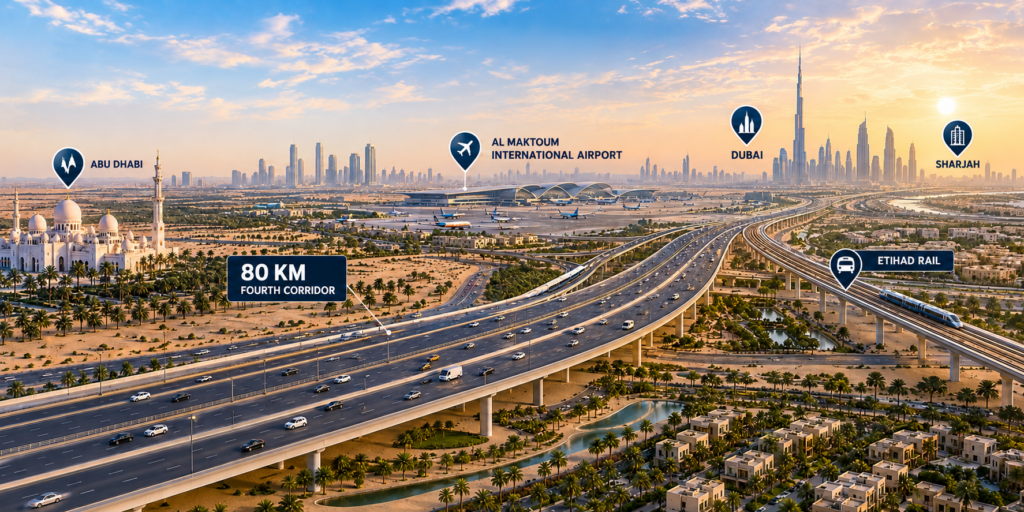
The UAE’s new Fourth Corridor is one of the most significant road infrastructure projects announced in 2026, creating a new strategic connection between Abu Dhabi, Dubai and Sharjah.
The approximately 80-kilometre corridor will extend from Al Faya Road in Abu Dhabi to Al Shanouf Road in Sharjah through Dubai. More importantly for property investors, it will connect several developing areas with major economic and transport infrastructure, including Al Maktoum International Airport and the Etihad Rail route.
Infrastructure does not automatically make every nearby property a good investment. However, better accessibility can fundamentally change how people evaluate where they are willing to live, work and invest.
For investors already comparing opportunities across the UAE, the Fourth Corridor deserves attention as part of the wider infrastructure-led growth story shaping the country’s property market.
What Is the UAE Fourth Corridor?
The Fourth Corridor is a planned strategic highway connecting Al Faya Road in Abu Dhabi with Al Shanouf Road in Sharjah through Dubai.
The project will extend for approximately 80 kilometres and is being implemented in two phases.
Official plans include:
- 72 bridges
- 17 tunnels
- 45 stormwater drainage culverts
- up to 12 lanes across both directions
- capacity of up to 24,000 vehicles per hour in both directions
The corridor is intended to strengthen connections between the emirates, support logistics activity and provide infrastructure for expanding residential and development areas.
It will become another major inter-emirate road axis alongside Sheikh Zayed Road and Al Ittihad Road, Sheikh Mohammed bin Zayed Road and Emirates Road.
What Are the Two Phases of the Fourth Corridor?
Phase 1: Sharjah to Dubai–Al Ain Road
The first phase will extend approximately 30 kilometres from Al Shanouf Road in Sharjah to Dubai–Al Ain Road.
The official plan includes major road, bridge, ramp, tunnel and intersection works, as well as widening sections of Dubai–Al Ain Road.
According to the RTA, one journey along this section is expected to fall from around 35 minutes to approximately 14 minutes once the infrastructure is operational.
The phase is expected to serve approximately 600,000 people.
These figures are planned project outcomes rather than guaranteed travel times for every journey.
Phase 2: Dubai–Al Ain Road to Al Faya Road
The second phase will extend approximately 50 kilometres from Dubai–Al Ain Road towards Al Faya Road in Abu Dhabi.
It is planned to provide similar high-capacity road infrastructure, with capacity reaching up to 24,000 vehicles per hour across both directions.
One relevant journey is expected to fall from approximately 50 minutes to 24 minutes.
The second phase is expected to serve around 3.1 million people.
The actual benefit to individual communities will ultimately depend on interchange locations, local access roads and how the surrounding districts develop.
Why Could the Fourth Corridor Matter to Real Estate?
For property buyers, distance is only part of the equation.
A home may appear far from a business district on a map, but if a new transport connection significantly reduces the journey, that community can suddenly become practical for a much larger group of residents.
This is one of the main reasons transport infrastructure can influence property markets.
Improved accessibility can:
- expand the geographical areas considered by tenants and buyers;
- support new residential communities;
- make employment centres easier to reach;
- increase the viability of retail and commercial projects;
- strengthen logistics and industrial districts;
- support long-term population expansion.
However, connectivity alone is not enough.
A successful property investment still requires the right combination of community planning, amenities, demand, developer quality and pricing.
The Fourth Corridor Could Expand the UAE’s Practical Housing Map
People rarely choose a home based purely on kilometres.
They consider questions such as:
How long will it take to reach work?
How easy is the school commute?
How quickly can I reach Dubai or Abu Dhabi?
Are shops, healthcare and services nearby?
Can I realistically live here every day?
When infrastructure reduces travel friction, previously less convenient areas can become legitimate residential alternatives.
This can be particularly important for emerging communities positioned between major economic centres.
Investors comparing these opportunities should also consider the broader fundamentals explained in my guide on buying property in Abu Dhabi in 2026.
Al Maktoum International Airport Is an Important Growth Driver
One of the most important locations connected by the Fourth Corridor is Al Maktoum International Airport, also known as Dubai World Central.
Dubai Airports says the airport is undergoing a major long-term expansion.
The planned development is expected to provide capacity for approximately 150 million passengers annually within the next decade and ultimately around 260 million passengers per year, together with approximately 12 million tonnes of annual cargo capacity.
The airport is also planned with five runways.
That scale matters to property investors because major airports can generate entire employment ecosystems.
Growth around aviation can create demand for:
- residential accommodation;
- offices;
- logistics facilities;
- hotels;
- warehouses;
- retail;
- supporting commercial services.
The Fourth Corridor could improve accessibility between these employment areas and residential districts across Dubai, Sharjah and parts of Abu Dhabi.
Airport proximity should still be assessed carefully. Flight paths, noise, traffic and the actual distance to the nearest highway interchange can materially affect individual properties.
Etihad Rail Strengthens the Wider Connectivity Story
The Fourth Corridor also passes through or near the Etihad Rail route.
Etihad Rail’s national railway network extends approximately 900 kilometres across the UAE and connects major cities, industrial centres and ports.
Passenger operations are now being introduced in phases.
The first scheduled passenger service between Fujairah and Abu Dhabi began on June 30, 2026.
Dubai and Al Dhaid stations subsequently joined the passenger network on September 30, 2026, with further station openings planned.
For real estate investors, this is important because highways and rail networks do different jobs while reinforcing the same economic objective: improving connectivity between communities, employment centres and commercial hubs.
The strongest property locations may therefore be those benefiting from several infrastructure drivers rather than one isolated road project.
Could the Fourth Corridor Increase Property Prices?
Possibly — but investors should be careful with this question.
A new road does not automatically guarantee capital appreciation.
Infrastructure can increase the attractiveness of an area by improving accessibility, but property prices are also influenced by:
- housing supply;
- population growth;
- employment;
- developer reputation;
- construction quality;
- schools and amenities;
- rental demand;
- service charges;
- mortgage conditions;
- competing developments.
Property markets can also react to infrastructure projects in stages.
Stage 1: Announcement
Investors and developers begin identifying communities near the proposed route.
Stage 2: Construction
Confidence may improve as infrastructure becomes more tangible, although completion risk remains.
Stage 3: Opening
Real journey times and access patterns can finally be measured.
Stage 4: Community Maturity
Schools, retail, employment, healthcare and lifestyle infrastructure determine whether increased demand becomes sustainable.
The Fourth Corridor therefore makes selected locations more interesting to analyse, but it should never replace proper property due diligence.
Which Properties Could Benefit Most?
The most successful properties may not necessarily be the ones physically closest to the highway.
Investors should instead look for properties combining four important characteristics.
1. Practical Access
The community should have realistic access to the new corridor through confirmed roads and interchanges.
A project advertised as being “near the Fourth Corridor” may still require a long drive to reach an actual entrance.
2. Strong Community Planning
Schools, parks, healthcare, retail and leisure amenities help convert infrastructure accessibility into genuine residential demand.
3. Nearby Employment
Communities located close to employment centres, logistics hubs, airports and commercial districts can attract stronger long-term occupier demand.
4. Suitable Property Product
Unit sizes, layouts, purchase price, payment plan and service charges need to match the target buyer or tenant profile.
Those principles are equally important when evaluating the latest luxury property projects in Abu Dhabi.
Could Abu Dhabi Communities Benefit?
Potentially, particularly areas that gain improved access towards Dubai.
The Fourth Corridor starts from Al Faya Road in Abu Dhabi, meaning certain mainland and emerging locations could eventually benefit from greater regional accessibility.
However, investors should avoid assuming that every Abu Dhabi community automatically benefits equally.
The exact impact depends on:
- distance to the corridor;
- interchange accessibility;
- existing road connections;
- community maturity;
- employment drivers;
- future infrastructure planning.
For investors deciding between the two largest UAE markets, my detailed Abu Dhabi vs Dubai property comparison provides additional context on how each market currently differs.
What Should Investors Check Before Buying Near the Fourth Corridor?
Before buying a property based partly on future infrastructure, check the fundamentals carefully.
Confirm:
- the project’s exact geographical location;
- the distance to a confirmed interchange;
- whether access roads are officially approved;
- the construction timeline;
- the developer’s delivery history;
- nearby schools and services;
- expected community infrastructure;
- service charges;
- current and projected rental demand;
- competing future supply;
- the intended tenant or buyer profile;
- your expected investment holding period.
Most importantly, distinguish between infrastructure that has been announced, infrastructure currently under construction and infrastructure already operating.
These stages carry very different investment risks.
Infrastructure Is an Enabler, Not the Investment Thesis
The Fourth Corridor should be viewed as part of a much larger UAE development strategy.
Its connection between Abu Dhabi, Dubai and Sharjah, combined with Al Maktoum International Airport and Etihad Rail, creates a compelling long-term connectivity story.
But infrastructure alone cannot turn an average project into a strong investment.
A well-planned community with genuine demand, quality construction and sensible pricing may benefit significantly from improved connectivity.
A poorly positioned development may not.
For investors, the right strategy is therefore selective rather than speculative.
Final Outlook
The approximately 80-kilometre Fourth Corridor has the potential to reshape movement between parts of Abu Dhabi, Dubai and Sharjah.
Its scale, planned road capacity and connection to major infrastructure such as Al Maktoum International Airport and Etihad Rail make it particularly relevant to investors studying future growth corridors in the UAE.
The key is not simply buying property close to the highway.
Investors should look for locations where transport infrastructure is supported by employment, quality communities, amenities, credible developers and genuine end-user demand.
That combination — rather than infrastructure headlines alone — is what is more likely to create sustainable long-term property value.
The UAE Fourth Corridor is a planned approximately 80-kilometre strategic highway running from Al Faya Road in Abu Dhabi to Al Shanouf Road in Sharjah through Dubai. It is being implemented in two phases and is intended to improve inter-emirate connectivity, logistics movement and access to developing areas.
The corridor will connect Abu Dhabi, Dubai and Sharjah. Its planned route extends from Al Faya Road in Abu Dhabi through Dubai before reaching Al Shanouf Road in Sharjah.
The Fourth Corridor could strengthen property demand in selected communities by improving accessibility, but there is no guaranteed increase in property prices. Investors should also consider location, supply, developer quality, rental demand, amenities and entry price. Buyers can compare these fundamentals with Ayman Sadieh’s Abu Dhabi property investment guidance.
Properties with convenient access to confirmed interchanges, strong community facilities, nearby employment and sustainable tenant demand are more likely to benefit than properties that are simply geographically close to the highway. Buyers should evaluate the full community and master plan before investing.
Yes. Abu Dhabi continues to have active off-plan developments across locations including Yas Island, Saadiyat Island, Al Ghadeer, Hudayriyat Island, Al Raha Beach, Al Maryah Island and other investment areas. Buyers can compare current opportunities through NAS Luxury Real Estate’s Abu Dhabi off-plan property portal before deciding which location fits their investment strategy.