
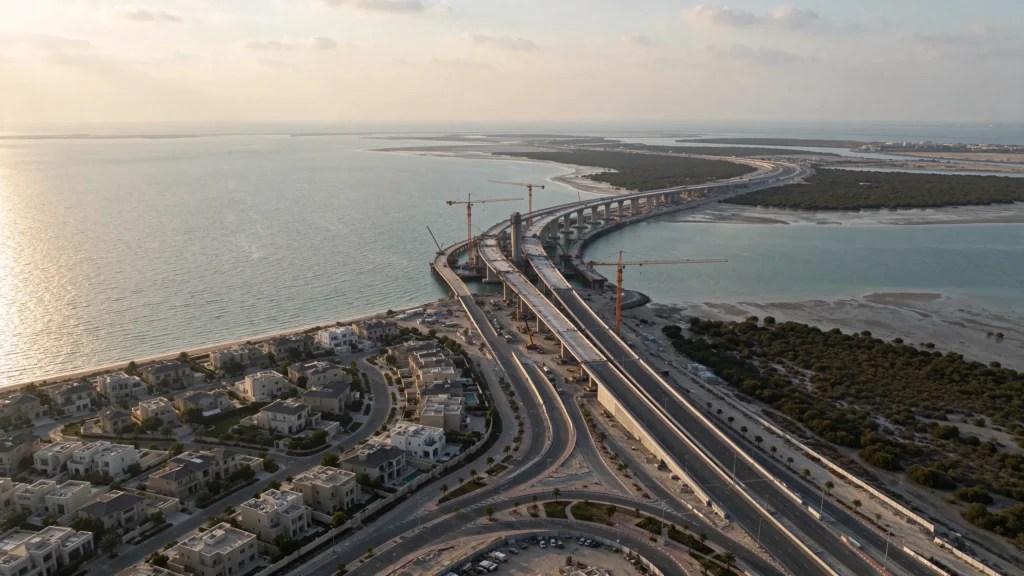
Abu Dhabi’s Department of Municipalities and Transport is developing a major road connection linking Jubail Island and Ramhan Island to Sheikh Khalifa bin Zayed Highway, E12. The project has a budget of AED 872 million and covers more than 166,000 square metres.
The development includes seven bridges, three tunnels, ramps, connecting roads and utility corridors. It is expected to be completed in 2027. The stated purpose is to improve road accessibility and capacity and support smoother traffic movement around the two island destinations.
For buyers considering Jubail or Ramhan property before the infrastructure is complete, the project is relevant. However, a planned road connection should be assessed as one part of a wider property decision. It should not be treated as proof of guaranteed price growth, rental returns or a fixed handover date for any home.
What the project confirms
The confirmed infrastructure facts are straightforward:
•The project connects Jubail Island and Ramhan Island to E12.
•It includes seven bridges.
•It includes three tunnels.
•It covers more than 166,000 square metres.
•It includes ramps, roads and utility corridors.
•Its budget is AED 872 million.
•Completion is expected in 2027.
Advanced works are underway. The project also includes energy-efficient LED lighting and a target to recycle approximately 90% of construction waste, equivalent to more than 2,200 tonnes, during implementation.
These details establish the scope of the infrastructure programme. They do not establish the exact journey time from a particular villa, the final traffic conditions after opening or the value of any individual property.
Why infrastructure matters to a property assessment
Road access affects how practical a location feels for residents, visitors, staff, contractors and future buyers. Improved connections may support easier movement between an island community and the wider Abu Dhabi road network.
Infrastructure can also help a developing destination keep pace with new homes and community facilities. That does not mean every property benefits in the same way. A home close to a convenient access route may have a different experience from one beside a future construction zone, internal road or bridge approach.
A buyer should therefore separate three questions:
1.What infrastructure has been officially announced?
2.What will the access experience be for the exact property?
3.Is the purchase price supported by current evidence rather than only by a future expectation?
Construction timing and the 2027 target
The project is expected to be completed in 2027, but buyers should avoid treating that year as a guaranteed date for every related development. Roads, bridges, utilities, landscaping, buildings, amenities and residential handovers can follow separate construction programmes.
Before buying an off-plan home, review the contractual handover date for the exact property or phase. Check the sale and purchase agreement, payment schedule, permitted extensions, service-charge arrangements and the developer’s stated delivery obligations.
It is also important to understand what access will be available before the new connection is complete. A buyer should ask for the current route to the property, temporary access arrangements, construction activity near the plot and the expected sequence of surrounding works.
The key question is not simply whether the bridge is expected to open in 2027. It is whether the property remains suitable if the infrastructure or the surrounding community is delivered later than expected.
How to assess Jubail Island opportunities
Jubail Island includes different residential environments, so island-wide assumptions can be misleading. Buyers may be comparing a completed family-oriented villa community with an off-plan home, a mixed-use apartment or a premium waterfront property.
The first step is to identify the village and the property type. Then assess the exact plot or unit position. Important points include waterfront exposure, orientation, privacy, neighbouring plots, road exposure, access to parks and community facilities, and any future construction visible on the master plan.
A buyer should also compare the home with genuinely similar properties. A villa with a larger plot, better privacy or a more distinctive waterfront position should not automatically be benchmarked against an interior villa with a different completion status.
For a detailed location framework, buyers can review Ayman Sadieh’s Jubail Island real estate guide, then verify the current availability, price and completion status of any specific listing before making a decision.
How to assess Ramhan Island opportunities
Ramhan Island is being developed as a low-density waterfront destination by Eagle Hills, with residential areas, a marina, retail and dining components forming part of the wider destination plan.
Its geography makes exact position particularly important. A residence may face open water, an internal channel, a bay, mangroves or a community area. These settings can create different levels of privacy, outlook, perceived scarcity and future competition.
Buyers should review the development phase, contractual handover date, amount already paid, remaining payment obligations and any seller premium. They should also understand whether the asking price reflects the property itself or relies heavily on expected future infrastructure.
A resale property and a developer release may have different financial profiles even when the homes appear similar. The remaining payment schedule, transfer costs, completion status and seller motivation can materially change the effective acquisition cost.
Ayman Sadieh’s Ramhan Island property advisory page provides a framework for comparing phase, water position, payment position, future surroundings and the buyer’s long-term objective.
How to use transaction evidence correctly
Infrastructure announcements can attract attention before they change completed market evidence. Buyers should therefore distinguish between asking prices, developer prices, resale expectations and completed transactions.
A strong comparison should use properties that are similar in meaningful ways, including:
•The same island or a genuinely comparable nearby location
•The same development or a comparable phase
•Similar plot size, built-up area and bedroom count
•Similar waterfront or internal position
•Similar completion and handover status
•Similar payment obligations and ownership costs
Where available, registered transaction evidence is more useful than relying only on advertised prices. A listing tells you what a seller wants to achieve. A completed transaction provides evidence of what a buyer actually agreed to pay, subject to the quality and comparability of the record.
One or two sales are not enough to establish a market trend. Buyers should examine the number of comparable transactions, the period in which they occurred, the condition of the properties and whether the sales involved unusual motivations or special terms.
Ayman’s Abu Dhabi luxury property projects can be used as a starting point for comparing different development types, but every opportunity still requires property-level verification.
What could make an opportunity attractive?
A Jubail or Ramhan property may deserve closer attention when its current price is supported by comparable evidence, its exact position is clearly understood, its payment obligations are manageable and its handover timeline matches the buyer’s objective.
The future bridge connection may add practical relevance to the location. The strongest case is not based on the bridge alone. It combines current usability, property quality, location scarcity, delivered or contracted amenities, realistic holding assumptions and evidence from comparable transactions.
What could create risk?
The main risks include paying a premium for an infrastructure benefit that has not yet been delivered, confusing the bridge completion target with a home handover date, overlooking construction activity near the property, and relying on asking prices as if they were achieved sales.
Other risks include underestimating remaining developer payments, future competing supply, service charges, resale liquidity and the difference between an attractive master plan and the facilities that are currently operational.
A property can remain desirable while still being overpriced. Conversely, a less prominent property can offer better value if its position, condition, payment status and comparable evidence are stronger.
A practical buyer checklist
Before reserving a property, ask for the following:
1.The exact development, phase, plot or unit number.
2.The contractual handover date and current construction status.
3.The remaining payment schedule and all transfer-related costs.
4.The current and expected access route before and after the bridge project.
5.The location of nearby roads, bridges, construction zones and utility corridors.
6.The property’s orientation, waterfront relationship, privacy and neighbouring plots.
7.Comparable completed transactions, not only current asking prices.
8.The future supply that may compete with the property during the intended holding period.
9.The status of community facilities, retail, schools, landscaping and other amenities relevant to the buyer.
10.The downside case if infrastructure or handover timing changes.
Final perspective
The AED 872 million connection is an important infrastructure development for the Jubail and Ramhan Island area. Its seven bridges, three tunnels, roads, ramps and utility corridors are expected to improve access and capacity when the project is completed in 2027.
For buyers, the opportunity lies in analysing what is already usable, what is contractually promised and what remains a future expectation. The bridge can be part of a strong property case, but it should never replace careful review of construction timing, exact plot position, payment obligations and existing transaction evidence.