
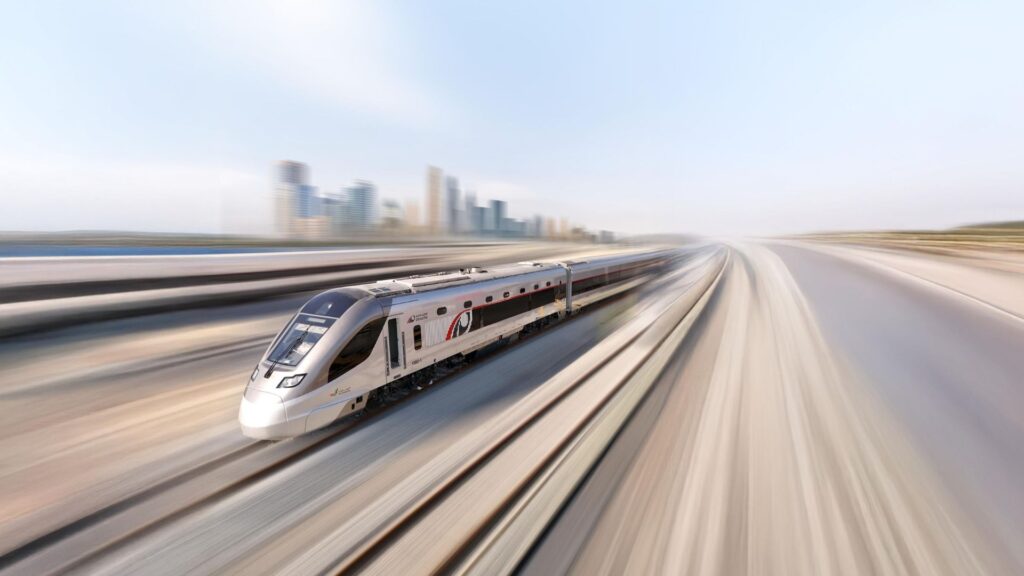
Infrastructure connectivity is the most powerful long-term driver of residential property appreciation that markets have ever known. When two cities that were previously two hours apart by car can be connected in 57 minutes by rail, every residential address within proximity of the rail station experiences a permanent increase in its utility and therefore its value. Etihad Rail, the UAE’s new 900-kilometre passenger rail network, is set to launch in phases throughout 2026, connecting 11 cities and regions across the Emirates with the first operational routes connecting Abu Dhabi, Dubai, and Fujairah.
For property investors, Etihad Rail’s launch represents the most significant infrastructure catalyst to emerge in Abu Dhabi and Dubai since the opening of the Dubai Metro in 2009. The data confirms it. Travel time from Abu Dhabi to Dubai will compress to just 57 minutes by passenger train. Abu Dhabi to Ruwais will take approximately 70 minutes. Abu Dhabi to Fujairah will take around 100 minutes. These journey times will permanently alter how commuters, investors, and families evaluate residential location decisions across the UAE’s key property markets.
The Service Specifications: What Passengers Get
Etihad Rail passenger trains have been designed with practical comfort as the priority. Each train will accommodate approximately 400 passengers and feature three distinct travel classes: Economy, Business, and First Class. Every passenger will have access to Wi-Fi and power outlets at their seat. The cabins feature comfortable seating, generous legroom, foldable tray tables, overhead storage, and designated spaces for larger baggage.
The station experience is equally thoughtful. Fujairah Station, the first fully completed Etihad Rail passenger station, features cream-and-grey interiors, expansive glass panels, clear signage, and automated smart electronic gates where passengers scan tickets to enter. According to Adhraa Almansoori, Executive Director of Commercial at Etihad Rail, the design philosophy has been deliberate: “We are very conscious that for many residents and many families, this will be their first experience of rail travel. That is why so much thought has gone into the station experience with clear signage, comfortable spaces, staff who are there to help.”
| Train Feature | Detail |
| Passenger Capacity | Up to 400 per train |
| Maximum Speed | 200 km/h |
| Travel Classes | Economy, Business, First Class |
| Onboard Amenities | Wi-Fi, power outlets at every seat, foldable tables, overhead storage |
| Station Design | Cream-and-grey interiors, smart electronic gates, clear signage |
Journey Times: The Metric That Drives Property Value
The most consequential numbers for property investors are journey times. Abu Dhabi to Dubai on Etihad Rail will take 57 minutes, compared to approximately two hours by car during peak traffic. Abu Dhabi to Ruwais will take roughly 70 minutes. Abu Dhabi to Fujairah will take around 100 minutes. Abu Dhabi to Sharjah will take approximately 35 minutes once the full network becomes operational.
When a 120-minute car journey becomes a 57-minute rail journey, the property market responds by expanding the geographic radius where buyers are willing to live while maintaining a commutable relationship to employment centres. This geographic expansion is how rail connectivity systematically increases property values. A residential address in Abu Dhabi that is now accessible from Dubai in 57 minutes becomes attractive to Dubai workers seeking lower property prices, more space, or family-oriented amenities that are more abundant in Abu Dhabi.
| Route | Journey Time |
| Abu Dhabi to Dubai | 57 minutes |
| Abu Dhabi to Ruwais | 70 minutes |
| Abu Dhabi to Fujairah | 100 minutes |
| Abu Dhabi to Sharjah | 35 minutes |
The First Operational Stations: Where Value Concentrates
The first passenger stations to become operational will be Mohamed bin Zayed City station in Abu Dhabi, Jumeirah Golf Estate station in Dubai, and Fujairah station. Additional stations will follow in phases throughout 2026 and into 2027, with the complete network eventually connecting 11 cities across the seven emirates, from Al Sila near the Saudi border to Fujairah on the UAE’s east coast.
Mohamed bin Zayed City, located in Abu Dhabi, is positioned as a major employment and residential node. Properties within walking distance or a short shuttle ride from Mohamed bin Zayed City station will experience the first wave of connectivity-driven appreciation. The station’s proximity to residential and commercial developments across the area means that developers and investors with holdings in this zone should prepare for increased demand and rental pressure as rail connectivity becomes operational.
The phased approach to station openings is strategically sound from an operational perspective, but it also creates a clear timeline for investors to identify which properties and developments will benefit first from rail connectivity. For investors seeking guidance on property positioning near Etihad Rail stations, working with a Luxury real estate investment advisor Abu Dhabi provides the market-level intelligence to identify which communities will benefit most from rail connectivity.
The Broader Network Impact: 11 Cities Connected
The complete Etihad Rail network will ultimately connect 11 cities and regions across the UAE, creating a unified mobility system that integrates with existing metro, bus, taxi, and local transport services. Passenger services will connect locations including Ruwais, Al Mirfa, Sharjah, Al Dhaid, Abu Dhabi, Dubai, and Fujairah, with future expansion plans to add Al Maktoum International Airport once the airport’s massive revamp is completed.
This broad network connectivity is not simply convenient. It is transformative for how people evaluate where to live relative to where they work. A professional working in Dubai can now consider purchasing property in Abu Dhabi with a 57-minute commute rather than a 120-minute car journey. A family in Sharjah can access Dubai employment in 35 minutes. These compressed geographies create concentric rings of opportunity where property prices rise as a function of being accessible to multiple employment and lifestyle centres simultaneously.
Property Investment Implications: Three Direct Mechanisms
Understanding how Etihad Rail translates into property value requires clarity on the specific mechanisms at work.
The first is commute-time compression. When a two-hour commute becomes 57 minutes, the geographic radius of commutable residential locations expands dramatically. Every property within that expanded radius becomes more valuable because it is now accessible to employment centres that were previously beyond a practical commute range.
The second is development-pattern clustering. Residential developments built near Etihad Rail stations will command premiums over comparable developments without rail access. Developers will build higher densities and higher-quality finishes near stations, creating secondary clustering effects that push up values across surrounding areas.
The third is population-distribution reshaping. As commuting becomes easier between emirates, professionals can make location decisions based on quality-of-life factors rather than proximity-to-work factors. Properties in more family-oriented, amenity-rich areas like Abu Dhabi will attract Dubai workers who previously had no practical option to live in Abu Dhabi while working in Dubai. This demand influx is the mechanism that drives sustained property appreciation.
Conclusion: Etihad Rail Is the Single Most Important Infrastructure Catalyst Since Dubai Metro
Etihad Rail’s 2026 launch, connecting Abu Dhabi to Dubai in 57 minutes, is infrastructure of generational significance for property markets across the UAE. The Dubai Metro, which opened in 2009, permanently transformed Dubai property values by making the city accessible from outlying areas. Etihad Rail will have an even more dramatic effect because it connects entire emirates, not just zones within a single city. For property investors with a multi-year horizon, positioning in communities near Mohamed bin Zayed City station, Jumeirah Golf Estate station, or other first-phase stations before operations begin is one of the most defensible entry decisions available in the current market.
Etihad Rail passenger services will launch in phases throughout 2026. The first operational routes will connect Abu Dhabi, Dubai, and Fujairah, with journey times of 57 minutes between Abu Dhabi and Dubai, approximately 70 minutes to Ruwais, and around 100 minutes to Fujairah. For guidance on Abu Dhabi real estate investment advisor services tailored to Etihad Rail connectivity, contact our team.
Etihad Rail trains will feature three travel classes: Economy, Business, and First Class. All passengers will have access to Wi-Fi and power outlets at their seat, foldable tray tables, overhead storage, and designated baggage spaces. Each train will accommodate approximately 400 passengers with maximum speeds of 200 km/h.
The first passenger stations to become operational will be Mohamed bin Zayed City station in Abu Dhabi, Jumeirah Golf Estate station in Dubai, and Fujairah station. Properties within proximity to these first-phase stations will experience the earliest connectivity-driven appreciation. Properties within proximity to these first-phase stations will experience the earliest connectivity-driven appreciation. Our trusted real estate brokerage maintains curated listings of developments positioned for maximum Etihad Rail connectivity benefit.
The complete Etihad Rail network will eventually connect 11 cities and regions across the seven UAE emirates, spanning 900 kilometres from Al Sila near the Saudi border to Fujairah on the east coast. The phased operational approach means different stations will open at different times throughout 2026 and into 2027.
When commute time between Abu Dhabi and Dubai compresses from approximately 120 minutes by car to 57 minutes by rail, the geographic radius of commutable residential locations expands dramatically. This expansion increases the value of properties in both emirate’s because they become accessible to employment and lifestyle centres in the other emirate. Properties within walking distance or short shuttle distance from Etihad Rail stations will experience the most significant appreciation. For a personalised property analysis tied to Etihad Rail station proximity and commute optimization, speak with our best real estate consultant abu dhabi team.