
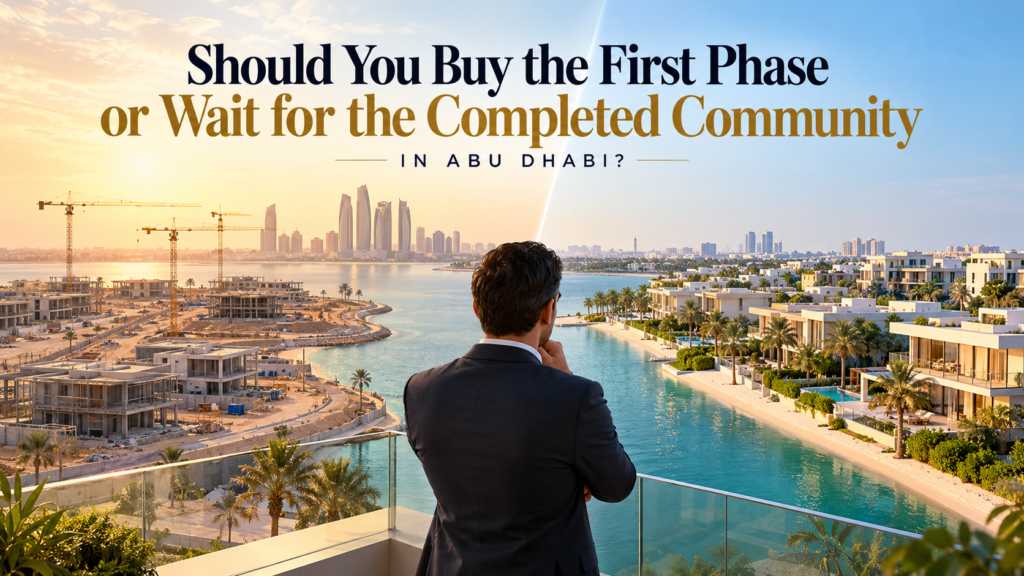
The answer depends on what you are buying: early position in a future destination, or certainty in an established one.
Buying the first phase of an emerging community may give you earlier access to the best plots, views, layouts, and orientations. It may also provide a more attractive entry point, a longer payment period, and the possibility of becoming an early owner in a limited part of the masterplan.
Waiting until the community is completed gives you something that no brochure can provide: evidence. You can see the finished architecture, experience the arrival, test the roads, assess privacy, understand the service charges, observe the amenities, and judge whether the completed community feels as considered as the original vision.
For a luxury buyer, this is not simply a question of whether prices will rise. It is a question of how much uncertainty you are willing to accept in exchange for early access and scarcity.
Why off-plan deserves a serious place in the comparison
Off-plan is not a marginal part of Abu Dhabi’s current market. It is one of the main ways luxury buyers are accessing new waterfront, branded, villa, and masterplanned communities.
Savills reported that off-plan accounted for 81% of Abu Dhabi City’s residential transactions in Q1 2026. It also reported that average off-plan sales rates increased 39% quarter-on-quarter to AED23,067 per square metre during that period, while the ready market increased 2.66% to AED15,480 per square metre. This is a significant market signal, but it is an average across a market—not proof that every launch or every unit increased by 39%.
ADREC’s H1 2026 market report provides another measure of the strength of the segment. Residential unit sales reached AED70.4 billion, and off-plan transactions represented 89% of residential sales value and 82% of residential deals. ADREC also reported that repeat-sales prices rose 20% year-on-year for apartments and 12% for villas. These figures help explain why early-stage projects have attracted attention, but they should not be used as a substitute for project-level evidence.
The more useful question is therefore not “Did Abu Dhabi off-plan prices boom?” They did show strong market-level growth in the cited periods. The more useful question is which locations, developers, unit types, views, payment structures, and delivery stages captured that demand—and whether the same conditions still apply to the residence being considered today.
What the recent off-plan price growth really tells a luxury buyer
The recent figures suggest that buyers have been willing to pay for new product, particularly where the launch offers something difficult to find in the completed market: a new waterfront setting, a recognised brand, a limited villa position, a distinctive masterplan, or a payment structure that allows the buyer to enter before completion.
They do not prove that a buyer can reserve any unit and resell it at a profit. Price growth may be concentrated in certain communities, unit sizes, views, release dates, and developers. A project with a strong headline increase can still contain units that are difficult to resell because of poor orientation, high service charges, weak layouts, or excessive competing supply.
There is also a difference between market appreciation and buyer profit. The buyer’s actual result is affected by the purchase price, payment timing, transaction costs, outstanding instalments, assignment conditions, service charges, financing, furnishing, and the price at which a buyer is genuinely willing to transact. A higher asking price on a portal is not the same as a verified sale.
For this reason, the strongest off-plan content should show both the opportunity and the evidence gap. It should explain what has already happened, what is being assumed, and what must still be proven at handover.
The comparison at a glance
| Consideration | Buy the first phase | Wait for the completed community |
| Unit selection | Usually stronger access to preferred plots, views, orientations, and layouts | Choice may be narrower, but the quality of each option can be assessed in reality |
| Pricing | May provide early-cycle pricing or a staged payment structure, but this is not guaranteed | The price reflects more visible evidence and may include a maturity premium |
| Views and privacy | Future view lines must be checked against the full masterplan | Existing views, noise, privacy, and neighbouring buildings can be inspected directly |
| Amenities | Some facilities may be planned rather than operational | The buyer can use and evaluate the completed amenity offer |
| Community feel | The buyer is purchasing a future experience | The buyer can assess the finished social and residential atmosphere |
| Construction risk | Greater exposure to delays, design changes, and incomplete surroundings | Lower development uncertainty, although building and management quality still require inspection |
| Service quality | Promised services must be tested through the operator and documents | Staff, maintenance, security, and service standards can be observed |
| Rental evidence | Forecasts may be based on assumptions and comparable areas | Actual rents, occupancy, tenant profile, and competing supply can be analysed |
| Holding period | Usually requires greater patience | More suitable for immediate occupation, leasing, or near-term resale |
| Luxury appeal | Early access to scarcity and first-choice inventory | Proven quality, established privacy, and a more complete ownership experience |
Neither route is automatically superior. The right decision depends on the strength of the location, the credibility of the developer, the quality of the first phase, the buyer’s intended use, and the terms of the purchase.
Why luxury buyers consider the first phase
1. First access to the most important details
At the top end of the market, the difference between an exceptional residence and an ordinary one can come down to details that are difficult to replace later: a protected water view, a private arrival, a larger garden, a quieter orientation, a corner position, a better relationship to the beach, or a more discreet distance from roads and public amenities.
The first phase may offer access to these choices before the most desirable inventory is absorbed. This can be valuable when the masterplan contains a genuinely limited number of beachfront plots, private villas, or residences with a particular outlook.
For a private client, first choice is not simply a matter of selecting the largest residence. It may mean choosing the home with the most composed arrival, the least exposed terrace, the best separation from service roads, or the right relationship between indoor and outdoor living. A residence facing the water may still be compromised by a public path, a future marina activity zone, or a neighbouring plot. The value lies in understanding the complete setting before selecting the unit.
This is where early advice can make a meaningful difference. A floor plan should be reviewed alongside the masterplan, not in isolation. The buyer should understand where guests arrive, where staff and deliveries move, how the main living areas face, how bedrooms are separated, and whether the outdoor spaces feel genuinely private. These are qualities that influence daily life long after the launch campaign has ended.
However, early access is only an advantage when the buyer understands the full future plan. A view that appears open today may face a later phase, road, hotel, clubhouse, or neighbouring building. The first phase creates selection opportunity, but it also requires more careful spatial analysis.
2. Early ownership in a scarce address
An emerging island destination may offer a type of setting that becomes difficult to reproduce once the masterplan is established. Early buyers may be attracted by low density, waterfront positioning, generous plots, or a distinctive architectural vision.
This can be meaningful for an owner buying a long-term family residence or legacy asset. The appeal is not only financial. It may be the opportunity to secure a particular position before the address becomes more widely recognised.
Scarcity should still be tested. A project may be marketed as exclusive while releasing many similar units across several future phases. Ask how many comparable residences will ultimately exist, whether later phases will offer stronger amenities, and whether the first phase will remain the most private or become surrounded by additional development.
True scarcity is usually physical rather than verbal. A coastline, a particular bend in a canal, a mature landscape, a low-density plot, or an uninterrupted view corridor may not be reproducible in a later phase. By contrast, a “limited release” can simply mean that the developer is releasing the project in stages. The buyer should distinguish between limited availability today and limited supply over the life of the masterplan.
The first phase is most compelling when it has a permanent relationship with the destination. If later phases will place the best club, beach, park, or hospitality facilities elsewhere, the original launch position may not remain the strongest. A careful buyer therefore studies not only what is being sold, but also what is still to be built around it.
3. A longer period to shape the ownership experience
Early purchasers may have more time to plan interiors, landscaping, furniture, staff accommodation, smart-home systems, art placement, and family use. In a large private residence, this planning period can be valuable.
A luxury home should not be treated as a standard unit with expensive finishes. Its success depends on how well the residence supports arrival, entertaining, family life, privacy, service, storage, guest use, and daily movement. Buying early can create more time for that work, subject to the developer’s alteration rules and handover process.
This is particularly relevant for larger villas, duplexes, and branded residences where the owner may be planning more than furniture. The buyer may need to consider art lighting, acoustics, kitchen use, staff circulation, wardrobe capacity, guest privacy, children’s rooms, outdoor entertaining, and the practical movement of household staff. Early access can allow these decisions to be made thoughtfully, but only if the developer permits the required customisation and the final specifications are documented clearly.
4. Potentially more efficient capital deployment
Off-plan purchases may offer staged payments rather than the entire capital requirement at completion. This can improve planning for a buyer with a clear multi-year horizon.
The payment plan should not be confused with a lower total cost. The buyer still needs to account for reservation payments, instalments, registration or transaction costs, furnishing, financing, service charges, and the possibility that the property may not generate income before handover.
A staged payment plan is helpful only when it matches the buyer’s cash flow and does not create pressure during construction.
Luxury buyers should also consider the opportunity cost of waiting for completion. Capital may remain committed for several years before the owner can occupy, lease, or resell the residence. During that period, the buyer may still be paying for another home, temporary accommodation, furnishing preparation, financing, or other property obligations. The payment plan should therefore be reviewed as a complete ownership timeline, not presented as a simple monthly convenience.
Why luxury buyers wait for completion
1. The finished residence tells the truth
A completed community allows the buyer to assess what renders cannot show:
•How private the entrance really feels.
•Whether the arrival sequence is calm or congested.
•How close neighbouring residences are.
•Whether landscaping has matured.
•How sound travels across the community.
•Whether the views are as open as expected.
•How the building, villa, or townhouse sits within its surroundings.
•Whether the materials and detailing feel genuinely premium.
For an owner who values quietness, discretion, natural light, or a particular sense of arrival, this evidence can be more important than an early price advantage.
Completion also reveals the relationship between the private residence and the wider community. A villa may have beautiful internal finishes but feel exposed because of its neighbouring plots. An apartment may have an impressive view from the living room but overlook a service entrance from the bedrooms. A tower may have a polished lobby but insufficient lift privacy during busy periods. These are not details that can be judged reliably from a brochure image.
For a luxury buyer, a completed viewing should be slow and deliberate. Arrive at a normal time of day. Listen from the terrace and bedrooms. Walk from the parking space to the entrance. Look at the distance between balconies. Check whether public amenities feel separate from private areas. Observe whether the landscape provides genuine screening or only visual decoration. The purpose is to understand how the property lives, not simply how it photographs.
2. Amenities and services can be tested rather than promised
Luxury is not defined by the presence of a spa, private club, beach lounge, concierge desk, or landscaped courtyard on a masterplan. It is defined by how those elements operate.
A completed community allows a buyer to observe opening hours, staffing, cleanliness, maintenance, privacy, booking procedures, resident access, guest access, and the relationship between private and public spaces.
The same principle applies to branded or managed residences. The name of the operator may be important, but the ownership documents, service structure, staffing, maintenance, and resident experience determine whether the promise is delivered.
This distinction is especially important in an emerging island destination. During the early years, a community may have excellent future plans but limited operating depth. A club may not be fully staffed, restaurants may not yet be open, landscaping may still be immature, and some services may operate on a temporary schedule. None of this necessarily makes the project unsuccessful, but it affects the experience of an owner who expects an established luxury environment from the first day.
Waiting allows the buyer to distinguish between a genuine service culture and an attractive list of amenities. The most valuable question is not “Does the project have a spa?” but “How well is the resident experience delivered, and what does it cost to maintain?”
3. Real rental and resale evidence becomes available
Waiting gives investors more information about the actual market. You may be able to review achieved rents, time on market, tenant profile, resale listings, service charges, and the number of competing homes.
This does not remove market risk, but it reduces the need to rely on assumptions. A completed community may also have a more recognisable address, which can help a buyer or tenant understand the product more quickly.
For a high-value residence, liquidity should be considered in practical terms. How many buyers can comfortably purchase the property? Are they end users, family offices, corporate tenants, or short-term investors? Does the residence require a specific lifestyle or service preference? Is the annual cost acceptable to the next owner? A completed community gives you a clearer answer because the market has had an opportunity to react to the finished product.
The trade-off is that the initial scarcity or payment-plan advantage may have passed. The buyer pays for greater visibility, not necessarily a lower price.
4. Immediate lifestyle and income
A completed community is usually more suitable for a buyer who wants to occupy the home soon, host family, relocate, or begin leasing without waiting through a multi-year construction period.
This matters particularly for private clients who are not trying to maximise theoretical upside. If the residence is intended as a personal base in Abu Dhabi, the value of immediate use may outweigh the possibility of securing an earlier price.
Immediate use also has an emotional and practical value that is difficult to include in a spreadsheet. A completed home can host family, accommodate visiting guests, support a work pattern, and become part of the owner’s routine immediately. For a residence intended as a long-term retreat or family address, several years of actual use may be more valuable than an uncertain expectation of future appreciation.
The most important luxury question: will the first phase age well?
The first phase should be assessed not only as a launch, but as a future address.
Ask whether the residence will still feel private when the complete masterplan is delivered. Ask whether later phases will be larger, more prestigious, closer to the beach, or better connected to amenities. Ask whether the first phase will benefit from the completed destination or become a less central part of it.
A strong first phase usually has at least one enduring advantage:
•An irreplaceable waterfront or park position.
•A limited number of residences.
•A genuinely superior view corridor.
•A more private or lower-density setting.
•A distinctive architectural identity.
•Direct access to the community’s most important amenity.
•A location that later phases cannot reproduce.
If the first phase has no permanent advantage beyond being launched first, waiting may be the more rational luxury decision.
The first-phase due-diligence framework
Before reserving an early-phase property, review the following.
Masterplan reality
Obtain the most current masterplan and identify all future plots, roads, hotels, retail, schools, clubs, beaches, service areas, and construction zones. Do not rely only on the marketing image shown for the first phase.
View protection
Ask whether the view is contractual, indicative, or simply based on current site conditions. Confirm the height and position of future buildings, landscaping, roads, and public areas.
Delivery sequence
Understand which roads, entrances, utilities, amenities, landscaping, and neighbouring phases are expected to be delivered before or after your residence. A completed villa in an incomplete masterplan can have a very different experience from the finished destination.
Developer and contractor evidence
Review the developer’s completed communities, handover quality, defect management, maintenance standards, and record of delivering the type of product being sold. Luxury renders are not evidence of luxury execution.
Service and operating model
Confirm who will manage the building or community, what services are mandatory, how charges are calculated, whether a brand or operator is involved, and how the service experience will be funded.
Exit conditions
Read the assignment, resale, transfer, and payment obligations. A buyer may be able to sell before handover only under specific conditions, with developer approval or fees. This should be established before purchase, not after a change in circumstances.
Holding period
Assume that an emerging community may need time to mature. The buyer should be comfortable owning through construction, handover, landscaping, amenity opening, and the stabilisation of rental or resale demand.
Which buyer should choose the first phase?
The first phase may suit a buyer who:
•Wants first choice of a rare view, plot, orientation, or layout.
•Has a multi-year capital and ownership horizon.
•Understands that the community will evolve over time.
•Is buying for personal use, family use, or long-term legacy value.
•Can tolerate construction and delivery uncertainty.
•Has reviewed the full masterplan rather than only the first release.
•Is comfortable waiting for the destination to mature.
It may be less suitable for a buyer who needs immediate occupation, immediate rental income, proven service quality, or a short and clearly defined resale horizon.
Which buyer should wait for the completed community?
Waiting may suit a buyer who:
•Wants to see the finished residence and surrounding public realm.
•Values certainty over first choice of inventory.
•Needs immediate use or leasing.
•Wants actual service-charge, rental, and resale evidence.
•Is highly sensitive to noise, privacy, access, or construction activity.
•Prefers to judge the finished community before committing.
•Is willing to pay a possible maturity premium for reduced uncertainty.
Waiting is not the same as missing the opportunity. In a large masterplan, new resale inventory can become available after completion, and the buyer may gain a clearer view of which buildings, streets, plots, and orientations have genuinely performed well.
How Ayman would compare the two decisions
A useful private-client comparison should not begin with “How much will the price increase?” It should begin with five more important questions:
1.Is this residence for living, leasing, or long-term legacy ownership?
2.What permanent advantage does the first phase have?
3.What evidence will only become available after completion?
4.How much uncertainty is acceptable for this buyer?
5.Does the purchase remain attractive if the expected appreciation is slower than planned?
Ayman Sadieh’s website presents his background as more than 11 years in Abu Dhabi luxury real estate, AED 8 billion-plus in closed transactions and advisory value, and ADREC-licensed brokerage experience. Those are professional credentials stated on his website; they should support the advisory process, not replace independent verification of a project or its financial assumptions.
His stated approach is particularly relevant to off-plan decisions: review the master developer’s delivery record, test the intrinsic value of the location, assess whether the product is genuinely differentiated, model the secondary-market exit, and match the payment plan to the client’s cash flow. In practice, this means a project should not reach a private-client shortlist simply because it is new, branded, waterfront, or heavily promoted.
Ayman’s luxury off-plan advisory framework focuses on developer track record, location strength, product differentiation, secondary-market exit modelling, and the suitability of the payment plan to the client’s cash flow. These are the same tests that should be applied when deciding whether to enter a first phase.
For buyers comparing a current launch with established and emerging alternatives, Ayman’s latest Abu Dhabi luxury projects provide a starting point for reviewing branded, waterfront, and off-plan opportunities. Each project still requires separate verification of current pricing, availability, payment terms, and delivery status.
Use digital information before making an off-plan decision
Off-plan research should not depend only on a sales brochure or a developer presentation. A buyer can build a more reliable picture by combining official market data, registered transaction records, project documents, site visits, and resale evidence.
Ayman’s digital research ecosystem includes an Abu Dhabi transactions database that presents registered ADREC sales records by project and area. It is useful for checking whether a project or nearby community has recorded transactions, comparing price patterns, and identifying the difference between a marketing asking price and registered market evidence. The database should be treated as a research tool, not as a guarantee of future performance, and the latest records should be checked before publication or purchase.
For Hudayriyat-focused buyers, the dedicated resale resource can help connect project-level research with live resale availability. This is important because an off-plan purchase should be evaluated against the homes that a buyer could acquire today, not only against the developer’s future vision.
The strongest digital workflow is:
1.Start with the official ADREC market context.
2.Search registered transactions for the project and comparable communities.
3.Compare the launch price with current resale asking prices and, where available, completed transaction records.
4.Map the full masterplan and future competing supply.
5.Review the developer, operator, payment plan, service charges, and assignment conditions.
6.Visit the location and inspect the actual relationship between the residence, roads, views, amenities, and surrounding construction.
7.Ask whether the opportunity still works if the resale timeline is longer than expected.
Digital information is most valuable when it changes the questions a buyer asks. It should not be used to create a false sense of precision around a future handover price.
Final verdict: early access or proven excellence?
Buy the first phase when it offers a permanent advantage that later buyers may not be able to reproduce: an irreplaceable view, exceptional privacy, limited inventory, a superior plot, or a genuinely distinctive architectural position. Enter with a long-term horizon and accept that the destination will take time to become complete.
Wait for the completed community when your priority is certainty: real views, operational amenities, proven service, immediate use, established access, and evidence of rental or resale demand. You may pay more, and the most desirable inventory may already be gone, but you will be buying with greater knowledge.
For a luxury buyer, the best decision is rarely the one with the most exciting launch story. It is the one that remains compelling after the brochure is removed, the future supply is mapped, the annual costs are understood, and the finished experience is honestly compared with the alternatives.
Not necessarily. Early releases may offer staged payment plans or attractive initial pricing, but the total cost depends on the unit, payment structure, transaction costs, financing, furnishing, service charges, and market conditions. Completed properties may command a premium for established quality and certainty.
It can be advantageous when the residence offers a permanent benefit such as a protected view, superior privacy, a rare plot, or exceptional orientation. Buyers should review the full masterplan to determine whether future phases could affect those characteristics.
The main uncertainty is purchasing before the completed residential environment can be fully evaluated. Construction schedules, amenities, infrastructure, future supply, management quality, privacy, and daily living conditions can all influence the eventual ownership experience.
Buyers can inspect the actual residence, views, landscaping, roads, amenities, privacy, noise levels, management, service standards, and surrounding properties. They can also examine available rental and resale evidence.
Potentially, depending on the sale agreement, developer requirements, outstanding payments, transfer conditions, fees, and applicable regulations. Resale eligibility should always be confirmed before reserving.
Either may consider it, but their motivations differ. An end user may value early access to a rare residence and accept the waiting period. An investor must evaluate payment obligations, rental timing, competing supply, resale liquidity, and total holding costs.
Compare specific residences based on purchase price, total ownership cost, location, layout, privacy, views, amenities, developer reputation, management standards, future supply, rental evidence, and the intended holding period.
Waiting reduces development-related uncertainty, but it does not remove market risk. A completed property can still have high service charges, weak management, excessive competing supply, or an asking price that is difficult to justify.
No. Appreciation depends on market demand, location, property quality, supply, delivery performance, and broader economic conditions. Early purchase does not guarantee a profit.
Not automatically. A recognised brand may increase the property’s appeal, but actual investment performance depends on location, physical quality, service arrangements, annual costs, and future buyer demand.
Genuine scarcity generally comes from physical characteristics that are difficult to reproduce, such as an exceptional beachfront position, a limited number of residences, a protected view, superior privacy, distinctive architecture, or a rare plot configuration.
The answer depends on the individual property. Off-plan may offer early access to a distinctive location, while a completed residence provides visible evidence of the waterfront experience, privacy, amenities, and ownership expenses.
Review the masterplan, developer performance, contractual specifications, views, surrounding future construction, payment schedule, handover expectations, resale rules, management arrangements, service charges, and total acquisition costs.
Ayman Sadieh assists buyers in evaluating luxury residential opportunities across Abu Dhabi, considering location quality, property characteristics, developer credibility, privacy, lifestyle requirements, investment objectives, and long-term ownership value.
His advisory approach focuses on identifying properties that align with individual buyer needs rather than relying solely on launch promotions or projected price appreciation.
Whether you are considering a first-phase villa launch, a branded waterfront residence, or an established luxury community, selecting the right property requires more than comparing prices.
The strongest purchase decisions consider location, privacy, architectural quality, lifestyle, ownership costs, and long-term desirability.
Explore Abu Dhabi’s luxury property opportunities with Ayman Sadieh and make a more informed decision about your next residence or investment.