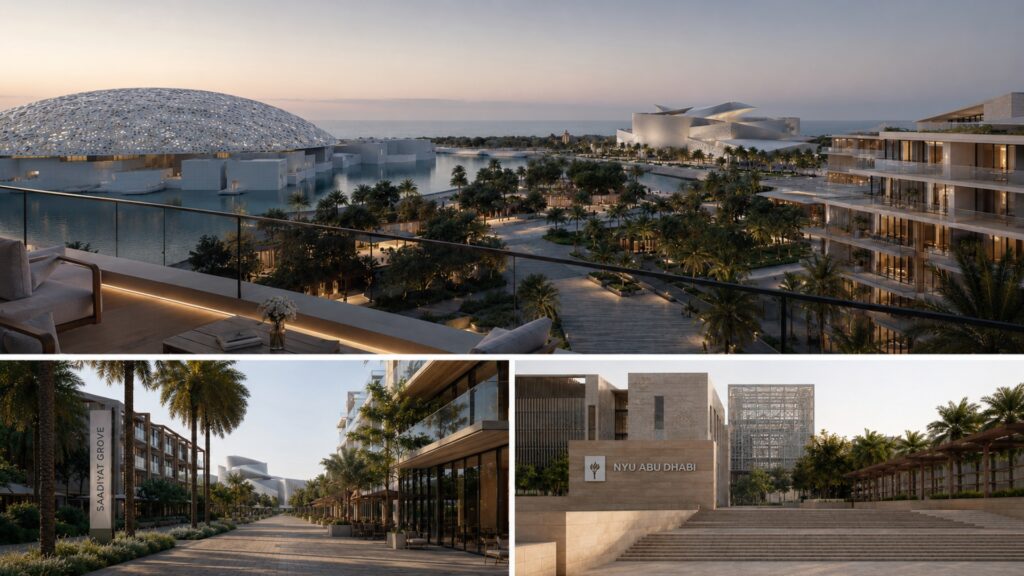
Most conversations about Saadiyat Island’s cultural premium treat it as an island-wide effect: proximity to “the museums” as a general lifestyle draw. That framing misses something more specific and more valuable. Within a genuinely walkable cluster on Saadiyat, the Louvre Abu Dhabi, NYU Abu Dhabi, and the soon-opening Guggenheim Abu Dhabi sit close enough together that residential developments are now being marketed and designed around direct sightlines to more than one institution simultaneously. This is not an island-wide halo. It is a specific, non-replicable micro-zone, and understanding its geography matters if you are trying to distinguish a good Saadiyat investment from an exceptional one.
The Geography: Mapping What Sits Where
The Saadiyat Cultural District is compact by design, built as a pedestrian-friendly neighbourhood with tree-lined promenades, landscaped plazas, and boutique retail connecting its institutions on foot rather than requiring a car for every trip between them. Within this district, several residential developments have been explicitly positioned and marketed around direct visual and physical proximity to more than one cultural anchor.
Baccarat Residences Saadiyat, officially launched by Aldar on February 10, 2026, is perhaps the clearest expression of this micro-zone effect. The 77-home development, designed by Sou Fujimoto in his first UAE project, offers panoramic views of Louvre Abu Dhabi, Guggenheim Abu Dhabi, and the Arabian Sea simultaneously, and sits close to Saadiyat Beach, Saadiyat Beach Golf Club, and NYU Abu Dhabi. It is described by Aldar as the final development to launch within the Saadiyat Grove district.
Louvre Abu Dhabi Residences, also developed by Aldar within Saadiyat Grove, places residents steps away from the Louvre while families benefit from the proximity of NYU Abu Dhabi and Cranleigh School, with three bus stations reachable within a 15 to 20 minute walk, connecting the Louvre and Mamsha Al Saadiyat directly.
| Development | Institutions in Direct View or Walking Distance | Developer |
| Baccarat Residences Saadiyat | Louvre Abu Dhabi, Guggenheim Abu Dhabi, NYU Abu Dhabi (nearby) | Aldar |
| Louvre Abu Dhabi Residences | Louvre Abu Dhabi (steps away), NYU Abu Dhabi, Cranleigh School | Aldar |
| Saadiyat Grove developments generally | Louvre, Guggenheim, Zayed National Museum, teamLab Phenomena | Aldar |
This walkable clustering of a major museum, a second incoming major museum, and a globally ranked university within a single pedestrian-friendly district is a genuinely rare urban configuration. Very few residential addresses anywhere in the world allow residents to walk to a Louvre-branded institution, a Guggenheim, and a top-tier university campus within the same afternoon.
Why Three Institutions Compound Rather Than Simply Add Up
A single museum draws visitors on a predictable but limited pattern: tourists, day-trippers, occasional repeat visits. A university changes that pattern entirely, because it introduces a resident population, faculty, researchers, visiting academics, and students, who live, work, and spend within the district year-round rather than seasonally. Add a second world-class museum into that same walkable radius, and the demand base compounds rather than simply stacking.
This is the structural logic behind why the Saadiyat Cultural District functions differently from a single-attraction address elsewhere on the island. NYU Abu Dhabi’s presence means the district has a built-in population of long-term residents whose housing needs are tied to academic calendars and multi-year appointments rather than tourism cycles. Layer the Louvre’s established 1.2 million annual visitors, which drove documented residential appreciation across Saadiyat following its 2017 opening, alongside the Guggenheim’s anticipated opening in late 2026, and the district gains a third, distinct demand driver: art-world tourism and the international collector, curator, and cultural-sector professional community that a Guggenheim opening typically attracts.
For investors, this compounding effect is the difference between a location that experiences a single demand spike around one attraction and a location with three overlapping, mutually reinforcing demand cycles operating simultaneously.
What This Means for Different Property Types
The three institutions do not drive the same kind of demand, and understanding which driver applies to which product type is essential for matching an investment strategy to the right asset.
NYU Abu Dhabi’s presence primarily supports long-stay rental demand from faculty, visiting researchers, and staff who need stable, walkable housing near campus for appointments typically spanning multiple years. This tenant profile favours well-located apartments and townhouses within Saadiyat Grove and adjacent communities, where lease stability and tenant quality tend to outperform pure short-term yield metrics.
Louvre and Guggenheim proximity, by contrast, supports a different investment thesis entirely: premium resale value and short-let potential aimed at cultural tourism and international buyers. Branded residences in culturally significant locations consistently outperform standard luxury developments in both capital appreciation and rental demand, a pattern already visible in how Baccarat Residences Saadiyat and Louvre Abu Dhabi Residences have been positioned, explicitly marketed around direct museum sightlines rather than generic island lifestyle messaging.
| Institution Proximity | Primary Demand Driver | Best-Suited Property Type |
| NYU Abu Dhabi | Long-stay faculty/staff rental demand | Apartments, townhouses near campus |
| Louvre Abu Dhabi | Tourism-driven resale premium, art-world buyers | Branded residences, view-oriented units |
| Guggenheim Abu Dhabi (opening late 2026) | Anticipatory appreciation, cultural tourism | New branded launches with direct sightlines |
For investors targeting yield stability, proximity to NYU Abu Dhabi and its associated long-term tenant base is the more defensible thesis. For investors targeting capital appreciation and prestige resale value, direct sightlines to the Louvre and Guggenheim, the specific feature both Baccarat Residences and Louvre Abu Dhabi Residences are built around, is the more relevant filter.
The Guggenheim Countdown Effect
The Guggenheim Abu Dhabi’s confirmed late-2026 opening functions as a forward catalyst that the market is already pricing in ahead of the actual opening date. This pattern is well documented globally: the original Guggenheim Bilbao’s 1997 opening triggered a sustained, multi-year appreciation cycle across its surrounding district that began before the museum itself opened, driven by anticipatory investment from buyers positioning ahead of the confirmed catalyst.
Saadiyat’s own history provides a closer, more directly comparable precedent. The Louvre Abu Dhabi’s 2017 opening demonstrably accelerated demand for surrounding residential real estate in the years immediately preceding and following its debut. With the Guggenheim now approaching its own confirmed late-2026 opening, developments explicitly marketed around Guggenheim sightlines, Baccarat Residences chief among them, are positioned to capture a comparable anticipatory value movement as the opening date approaches and the museum begins operating.
For buyers evaluating entry timing, this suggests the window between now and the Guggenheim’s actual opening carries a specific strategic value: positioning ahead of a confirmed catalyst rather than after it has already been fully priced in. For guidance on which specific developments within this cultural micro-zone offer the strongest positioning ahead of the Guggenheim’s opening, our team at Trusted VIP property broker Abu Dhabi tracks unit-level availability across Saadiyat Grove’s museum-facing developments specifically.
Conclusion: A Non-Replicable Cluster, Not a Generic Island Halo
The value proposition sitting within this specific walkable radius on Saadiyat Island cannot be recreated elsewhere on the island, let alone anywhere else in Abu Dhabi. It requires the precise, compact geography that places a major museum, a second incoming major museum, and a globally ranked university within genuine walking distance of one another, a configuration that took over a decade of deliberate cultural district planning to assemble and cannot be replicated on a new parcel of land regardless of budget. For buyers evaluating Saadiyat Island, the more precise and useful question is not simply “Saadiyat or not,” but specifically whether a given property sits within this particular triangle or merely somewhere on the broader island.
Baccarat Residences Saadiyat, launched by Aldar in February 2026 and designed by Sou Fujimoto, offers panoramic views of both the Louvre Abu Dhabi and the incoming Guggenheim Abu Dhabi simultaneously, alongside proximity to Saadiyat Beach, Saadiyat Beach Golf Club, and NYU Abu Dhabi. Louvre Abu Dhabi Residences, also by Aldar, sits steps from the Louvre with NYU Abu Dhabi and Cranleigh School nearby. For guidance on abu dhabi real estate investment advisor services covering this specific micro-zone, contact our team.
NYU Abu Dhabi introduces a resident population of faculty, researchers, and staff whose housing needs are tied to multi-year academic appointments rather than tourism cycles, providing a stable, long-term rental tenant base that complements the more tourism-driven demand generated by the Louvre and Guggenheim. This combination of resident and visitor demand is what distinguishes this specific cluster from a single-attraction address.
The Guggenheim Abu Dhabi is confirmed to open in late 2026. Historical precedent from both the original Guggenheim Bilbao and Saadiyat’s own Louvre Abu Dhabi, which accelerated surrounding residential demand around its 2017 opening, suggests properties with direct Guggenheim sightlines may experience anticipatory value movement as the opening date approaches. For access to properties in Saadiyat’s Cultural District, our advisory team maintains developer relationships across this specific cluster.
Proximity to NYU Abu Dhabi favours a yield-stability strategy, targeting apartments and townhouses suited to long-stay faculty and staff tenants. Proximity to the Louvre and Guggenheim favours a capital appreciation and premium resale strategy, particularly for branded residences explicitly marketed around museum views, which have consistently outperformed standard luxury developments in both appreciation and rental demand.
This specific configuration, a major museum, a second incoming major museum, and a globally ranked university within genuine walking distance of one another, is the result of over a decade of deliberate cultural district planning on Saadiyat and cannot be replicated on a new site regardless of available capital. It represents a fixed, non-replicable geographic asset rather than a feature any future Abu Dhabi development could recreate. For a best real estate consultant abu dhabi assessment of which specific units within this triangle best match your investment goals, speak with our advisory team.