Every established owner on Saadiyat Island should have noticed a specific phrase in Aldar’s July 22, 2026 announcement of Marsa Al Saadiyat: this AED 100 billion, 6.4 million sqm development represents the activation of the final phase of the Saadiyat Island masterplan. For anyone holding a unit at Park View, Saadiyat Beach Residences, or Soho Square, that word carries real weight, and it deserves a genuinely honest answer rather than a reassuring one.
Two outcomes are equally plausible from here, and both are worth taking seriously before drawing conclusions about what completion means for a property you already own.
Start With the Indicators That Actually Matter
Rather than opening with theory, the most useful place to start is with what existing owners should actually be watching over the coming 12 to 18 months, because both the optimistic and cautious cases below will resolve through this data, not through speculation.
The first indicator is rental yield movement within your specific sub-community. Established Saadiyat developments currently deliver yields ranging from roughly 5% to 8.3% depending on product type, with premium beachfront addresses like Mamsha Al Saadiyat performing at the higher end and more accessible communities such as Park View and Soho Square typically sitting between 5% and 7%. If those figures begin compressing meaningfully as Marsa Al Saadiyat’s new rental stock enters the market, that is a signal to act on. If they hold steady, the scarcity argument is playing out as expected.
The second indicator is resale velocity, specifically how quickly comparable units are transacting and at what premium or discount to recent sales. A slowdown concentrated in older phases relative to new sales momentum at Marsa Al Saadiyat would suggest demand rotating toward the new development rather than adding to island-wide demand overall.
The third and most telling indicator is simply how quickly Marsa Al Saadiyat itself sells. Strong, rapid absorption, comparable to how Four Seasons Private Residences Saadiyat generated over AED 4 billion in sales and AED 14,000 per sqft pricing within less than a year of launch, would actually be a bullish signal for the whole island, confirming that global demand for the Saadiyat address is expanding rather than being redistributed from within.
What a “Finished” Masterplan Actually Means
Saadiyat’s land area has always been fixed. Unlike Yas Island or Hudayriyat Island, where new parcels continue to be released, Saadiyat’s boundaries were never open-ended. Aldar describing Marsa Al Saadiyat as the final phase confirms something specific in practical terms: once this 6.4 million sqm development is fully built, no further major undeveloped land will remain available for future residential launches on the island.
This is a scarcity signal first and foremost. It is not a new dynamic being introduced. It is the confirmation of a dynamic that has already been driving Saadiyat’s performance for years. ValuStrat data shows Saadiyat apartments appreciated 32% year-on-year as of April 2026, with beach villas up 25 to 40% since 2022, growth explicitly attributed to the island’s fixed land area and low-density planning requirements combined with accelerating global demand from high-net-worth buyers.
The Bullish Case: Scarcity Rewards What’s Already Built
The argument for existing owners benefiting from completion is straightforward. Once an island’s masterplan is genuinely finished, its existing inventory becomes the only route to an already mature, fully amenitized address, rather than an unbuilt promise still years from delivery.
| Established Saadiyat Community | Typical Resale Range | Gross Rental Yield |
| Saadiyat Beach Residences (1-4BR) | AED 1.4M to AED 4.5M | 5% to 7% |
| Park View | AED 900K to AED 2.2M | 5% to 6.5% |
| Soho Square | AED 850K to AED 2.2M | 6% to 7% |
| Mamsha Al Saadiyat | AED 2.5M to AED 10M+ | 6.4% to 8.3% |
Owners at Saadiyat Beach Residences, ready since 2013, or at Park View near NYU Abu Dhabi, hold completed, income-producing assets in a location where every cultural and lifestyle amenity is already fully operational, from the Louvre Abu Dhabi to teamLab Phenomena to the Guggenheim opening later this year. Buyers who want genuine turnkey access to Saadiyat’s lifestyle without a multi-year construction wait increasingly have nowhere to look but the resale and ready-rental market once Marsa Al Saadiyat’s own product is absorbed. That structural reality, no future undeveloped alternative on the island itself, is what underpins the case for continued price support in older phases.
The Honest Counterpoint: New Supply Is Genuinely Competitive
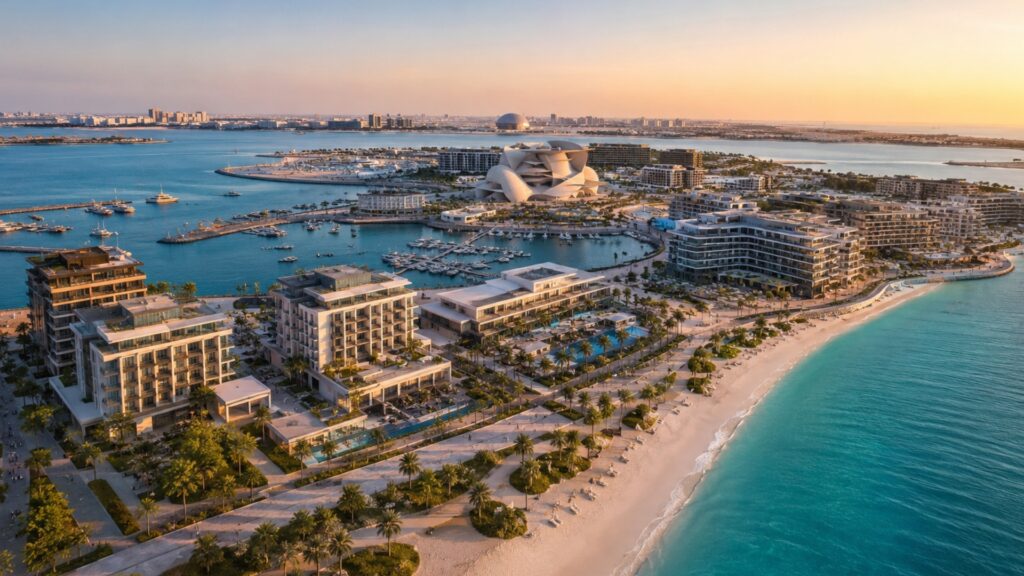
The caution deserves equal weight. Marsa Al Saadiyat is not a modest infill project. It will eventually house more than 58,000 residents across private mansions, luxury villas, waterfront apartments, and branded residences, centred on Abu Dhabi’s largest marina with capacity for 350 boats, a one-kilometre retail promenade, two luxury hotels, three new schools, and Dar al Funoon, a 6,000-capacity performing arts venue.
That is precisely the kind of brand-new, heavily amenitized stock that can pull rental and resale demand away from older phases, at least in the near term. A tenant comparing a 2013-built Saadiyat Beach Residences apartment against a new marina-adjacent unit at Marsa Al Saadiyat, complete with hotel-branded amenities and a purpose-built retail district, may reasonably lean toward the newer product while Marsa Al Saadiyat is actively establishing its rental base. With sales launching in H2 2026 and site works beginning in Q3, this competing supply will start entering the market within the next 24 months, not in some distant future. There is also the more immediate matter of construction activity itself: a project of this scale inevitably brings years of nearby building work that can affect the day-to-day living experience for existing residents, even while it ultimately builds long-term value.
Where This Leaves Existing Owners
Neither the bullish nor the cautious case should be treated as the settled outcome today. What determines which one plays out is the specific yield and resale behaviour in your own sub-community over the coming months, tracked against the pace at which Marsa Al Saadiyat itself sells and fills. Owners who actively monitor these three indicators, rather than assuming either automatic appreciation or automatic dilution, will be in the strongest position to make an informed decision about holding, refinancing, or selling. For a specific assessment of how your particular Saadiyat community is likely to be affected, our team at Trusted VIP property broker Abu Dhabi provides ongoing, data-led portfolio guidance rather than generic reassurance.
Conclusion: This Is a Question to Monitor, Not One to Assume
Saadiyat Island’s masterplan reaching completion through Marsa Al Saadiyat does not have a predetermined answer for owners of earlier phases. The scarcity case is well-supported by the island’s own price history. The competitive pressure from a genuinely large, highly amenitized new phase is equally real. The right response for current owners is not to pick a side today but to track the specific, observable signals, yield, resale velocity, and Marsa Al Saadiyat’s own absorption rate, as they unfold over the next year and a half.
Not necessarily, and it is too early to say definitively. The island’s fixed land supply has historically supported price appreciation of 8 to 12% annually and up to 40% for villas since 2022, and that scarcity dynamic does not disappear with Marsa Al Saadiyat’s arrival. However, a large new wave of amenitized stock could pull short-term demand toward the new development. The outcome depends on how yield and resale data move over the next 12 to 18 months. For a specific assessment, contact our abu dhabi real estate investment advisor team.
Yields range from approximately 5% to 8.3% depending on product and location. Premium beachfront developments like Mamsha Al Saadiyat sit at the higher end, 6.4% to 8.3%, while more accessible communities such as Park View and Soho Square typically range between 5% and 7%. Villas generally yield lower, around 4 to 6%, though they have historically shown stronger capital appreciation.
Marsa Al Saadiyat spans 6.4 million sqm and will eventually house more than 58,000 residents, a scale exceeding many of the island’s earlier phases combined. It includes Abu Dhabi’s largest marina, two luxury hotels, three schools, and a 6,000-capacity performing arts venue, alongside a full residential mix from private mansions to branded residences. Sales begin H2 2026. For portfolio guidance across Saadiyat Island’s evolving communities, our advisory team provides ongoing monitoring.
There is no blanket answer. This decision should be based on your specific unit’s current yield performance, resale conditions in your particular sub-community, and your own holding period goals, not a general assumption about the island as a whole. Monitoring rental yield trends and resale velocity in your specific community over the coming months is the more prudent starting point than an immediate decision either way.
The pace and pricing strength of Marsa Al Saadiyat’s own sales absorption is arguably the most telling indicator. Rapid, strong absorption, similar to Four Seasons Private Residences Saadiyat’s AED 4 billion in sales within under a year, would signal expanding global demand for the Saadiyat address as a whole, a positive read-through for established communities rather than a sign of demand being redistributed away from them. For a best real estate consultant abu dhabi assessment as this data becomes available, speak with our advisory team.